According to a 2023 study released by the World Population Review, Filipinos have been found to have a below-average intelligence quotient (IQ), highlighting the country’s position in terms of cognitive abilities.
While IQ is not the sole measure of intelligence, the findings have sparked discussions about education and intellectual development in the country.
The recent election of Bongbong Marcos, a politician with a controversial academic history, raises questions about the correlation between low IQ and political choices.
The World Population Review, an independent organization free from political affiliations, provides comprehensive demographic information on various countries. In their study, the Philippines ranked 111th out of 199 countries in terms of IQ, reflecting a below-average performance. Notably, Asian countries dominate the top positions on the list of countries with the highest IQ scores.
Here is a list of countries and their respective average IQ scores:
Japan – 106.49
Taiwan – 106.47
Singapore – 105.89
Hong Kong (China) – 105.37
China – 104.10
South Korea – 102.35
Belarus – 101.60
Finland – 101.20
Liechtenstein – 101.07
Netherlands & Germany (tie) – 100.74
Prior to his election in May 2022, Marcos faced criticism and calls to address misrepresentations regarding his academic credentials. It was revealed that he did not complete his BA in Philosophy, Politics, and Economics at Oxford University, despite enrolling in 1975. The university confirmed this information, leading to questions about transparency and honesty.
Given the low IQ status of Filipinos, as indicated by the study, it raises the question of whether this influenced the election of a controversial politician like Marcos. With over 31 million Filipinos casting their votes in his favor, it prompts an examination of factors contributing to political choices, including the influence of intelligence and critical thinking abilities.
It is essential to approach the correlation between IQ and political choices with caution. While intelligence is an important aspect of decision-making, other factors such as personal beliefs, charisma, political affiliations, and socioeconomic circumstances also come into play. However, the discrepancy between below-average IQ scores and the election of a candidate with a questionable academic history sparks discussions about the electorate’s discernment and the impact of intelligence on political choices.
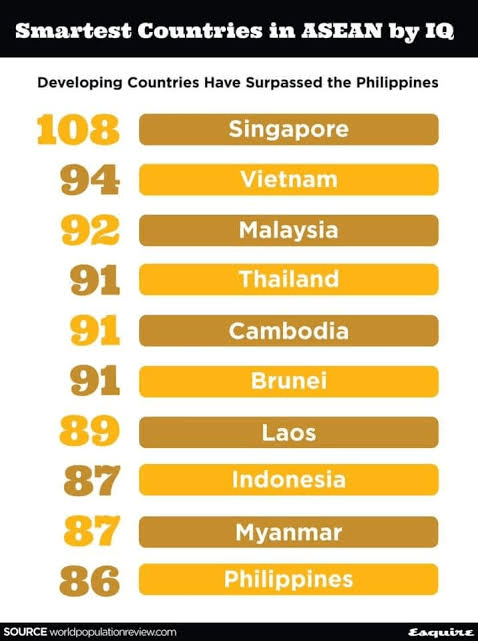
The findings of the WPR study, combined with Bongbong Marcos’s election and academic controversy, present an opportunity for further discourse on the correlation between IQ, political choices, and the overall intellectual landscape of the Philippines. It calls for a deeper examination of educational systems, critical thinking development, and the promotion of transparency in political leadership.
The study released by the WPR sheds light on the below-average IQ of Filipinos compared to global rankings. This raises questions about the correlation between intelligence and political choices, particularly in light of Bongbong Marcos’s election and his controversial academic history. While intelligence is not the sole determinant of political decisions, it prompts discussions about the electorate’s discernment and the impact of critical thinking abilities. As these conversations continue, it is crucial to consider the complexity of political decision-making, encompassing various factors that shape the democratic process in the Philippines.
 The Daily Netizen