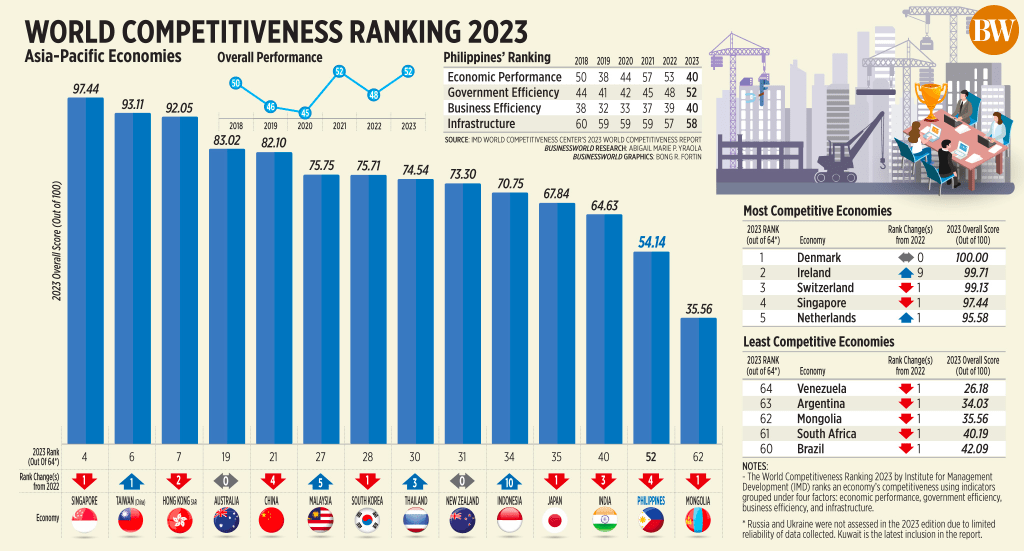
In the realm of global competitiveness, the Philippines has hit a stumbling block. Despite promises of job creation and progress, the country has experienced a sharp decline in rankings, leaving many questioning the effectiveness of President Bongbong Marcos Jr.’s strategies.
Corruption allegations have further marred his administration’s efforts, casting a shadow on the nation’s potential for growth. Let’s take a closer look at how the Philippines has dropped in terms of global competitiveness and the factors contributing to this decline.
According to the latest World Competitiveness Yearbook (WCY) prepared by the International Institute of Management Development (IMD), the Philippines has slipped four spots in the rankings. Previously at 48th place, the country now finds itself at the 52nd position among 64 economies. This drop can be attributed to declines in key areas such as infrastructure, government efficiency, and business efficiency.

The sub-factors falling under government efficiency have witnessed a downward trend. Public finance, tax policy, institutional framework, business legislation, and societal framework all experienced declines. Public finance slipped from 51st to 55th place, tax policy dropped from 13th to 14th, institutional framework declined from 53rd to 56th, business legislation fell from 52nd to 57th, and societal framework went down from 50th to 53rd.
The business efficiency factor also suffered a setback, with the Philippines ranking 40th, down from the previous year’s 39th place. Additionally, the country’s infrastructure factor experienced a decline, slipping to 58th place from the previous year’s 57th.
However, it’s not all gloom and doom for the Philippines. The country did show improvement in the economic performance factor, surging 13 places to secure the 40th position. This improvement can be attributed to advancements in the domestic economy, employment, and prices sub-factors.
The challenges ahead for the Philippines, as highlighted by the Asian Institute of Management Rizalino S. Navarro Policy Center for Competitiveness, include sustaining economic recovery and growth amidst global risks, strengthening social protection and healthcare systems, addressing learning gaps in the education system, investing in sustainable infrastructure, and reinforcing efficient public management strategies.
Unfortunately, the country continues to rank low within the Asia-Pacific region, maintaining its 13th position out of 14 economies for the past six years.
The World Competitiveness Yearbook evaluates economies using 255 criteria spread across four competitiveness factors: Economic Performance, Government Efficiency, Business Efficiency, and Infrastructure. The rankings are based on a combination of hard data collected from national sources and perception-based indicators gathered from an Executive Opinion Survey of managers.
This year’s rankings have been significantly influenced by multiple crises, including global inflation, the COVID-19 pandemic, and the conflict between Russia and Ukraine. Arturo Bris, the director of the World Competitiveness Center, acknowledges the impact of these crises on political fragmentation and the pursuit of self-interest by countries such as Singapore, Saudi Arabia, and India.
As we analyze the results, it becomes apparent that the Philippines’ competitiveness trajectory is not aligning with its aspirations. While other nations surge ahead, the Philippines finds itself grappling with challenges that hinder progress and undermine its potential. The country must address these issues head-on, focusing on transparency, efficiency, and the eradication of corruption if it hopes to regain its competitive edge on the global stage.
Denmark takes the top spot as the most competitive economy in the 2023 WCY rankings, followed closely by Ireland and Switzerland. In the Asia-Pacific region, Singapore, Taiwan, and Hong Kong claim the top three spots.
As the global landscape continues to evolve, it is crucial for the Philippines to reassess its strategies, prioritize good governance, and foster an environment conducive to innovation and growth. Only then can the country truly realize its potential and regain its footing on the path to global competitiveness.
In a surprising turn of events, Kuwait has joined the ranks of surveyed economies for the first time and secured a respectable 38th place among the 64 economies assessed.
The journey to competitiveness is not an easy one, but with determination, dedication, and a commitment to reform, the Philippines can overcome its current challenges and rise to the occasion. The time for change is now.
 The Daily Netizen