
Disappointment struck tens of thousands of passionate Taylor Swift fans in the Philippines, known as “Swifties,” when their idol decided to skip the country for her highly anticipated concerts this year. It left many wondering why Taylor Swift chose to exclude the Philippines from her tour, especially when online surveys indicate that Filipinos rank among the top three Swift fandoms worldwide, following India and the United States.
The answer seems to boil down to one word: MONEY. A sociologist, who took a deep dive into Taylor Swift’s concert history, suggests that money is the ultimate expression of hardcore love for the pop princess.
While some viral videos claimed that Taylor Swift doesn’t perform for “poor b***hes,” these AI-generated clips were likely created to convey the perception that financial considerations play a significant role. Yes, it seems money is at the heart of the matter!
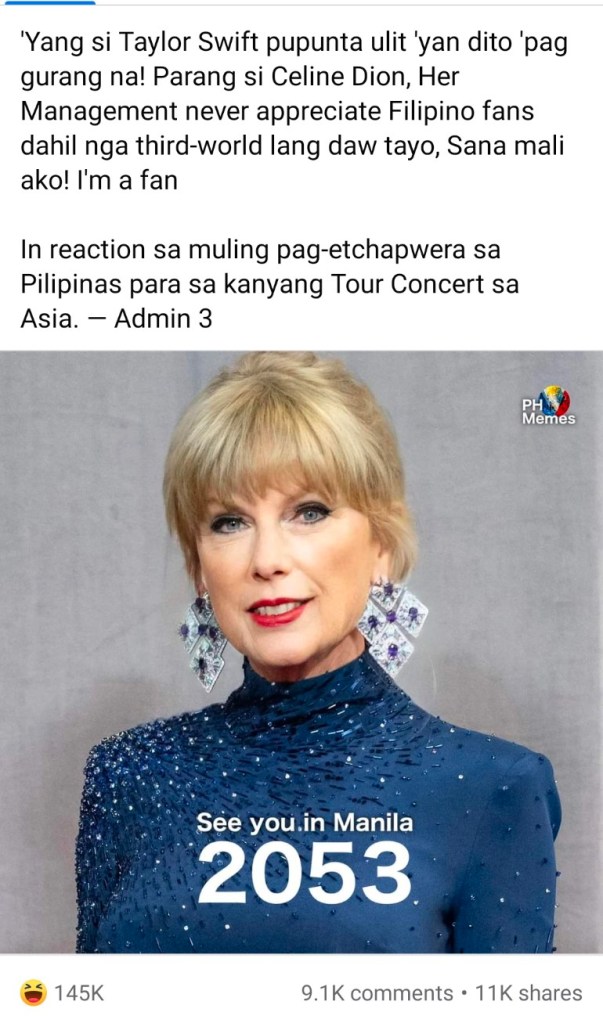
In the days following Taylor Swift’s announcement of her updated concert schedule, the Philippine media and social media platforms buzzed with pleas for the singer not to skip the country.
Swifties went into overdrive, flooding the internet with memes and parodies, all in an effort to convince Taylor Swift why the Philippines is the perfect place for her to perform. Among the many locations in the Philippines, Quezon City stood out as one of the top cities worldwide where Taylor Swift’s songs dominate Spotify playlists.

Despite their best efforts, Taylor Swift’s return to the Philippines didn’t materialize. Even events like the “Fan Nights: The Eras Festival in Manila,” drag shows organized by fans in March and May, aimed to petition Taylor Swift for another tour in the country. Unfortunately, their efforts were in vain, leaving Pinoy Swifties in a state of disappointment.
However, it’s essential to consider the reasons why Taylor Swift might choose to skip the Philippines and focus on already established markets in wealthier and more developed nations.
Let’s face it, the Philippines is categorized as a third-world country and, in comparison to countries like Japan, Australia, Switzerland, Germany, Italy, and the UK, it falls behind in terms of economic status. Taylor Swift’s decision to choose Singapore as a strategic location holds merit. Singapore undeniably serves as a cultural hub in Asia, hosting shows like “Asia’s Got Talent,” and it boasts a reputation as one of the freest and most capitalist nations on the continent.

So, the prevailing reason behind the omission of the Philippines from Taylor Swift’s tour is undoubtedly financial. If Swifties weren’t aware yet, organizing and executing concerts in the country can be quite expensive and impractical. Additionally, there’s the concern of potential backlash from local artists who may use such events as an opportunity to advocate for taxing and regulating foreign artists to protect their local counterparts.
The process of booking foreign artists for concerts in the Philippines is considered a gamble. It’s not solely a matter of demand; other factors come into play. Organizers face the challenge of shouldering expenses such as airfare, lodging, equipment handling, shipping permits, and more for not just the artist but also the band members, backup dancers, road managers, and security personnel.
Venue selection, local permits, taxes, and royalties further contribute to the financial burden. From equity clearance and royalty fees to entertainment taxes, local government taxes, working visas, and even barangay and police clearances, there are multiple slices to the ticket price pie that fans often overlook. The exact purpose of some of these fees, like the equity fee, remains a mystery even to insiders.
Moreover, there’s an inherent risk involved. Low ticket sales, the potential for artists to cancel at the last minute, production issues, and scalping are all concerns that organizers must grapple with. While other countries have taken measures against scalping by voiding tickets on the resale market, no such actions have been implemented in the Philippines at present.
Understanding the economics at play reveals why some concerts are priced higher than others. It ultimately comes down to demand. The more famous an artist, the higher the ticket prices. However, this isn’t always a straightforward equation. Sometimes, promoters can only estimate an artist’s worth once they arrive in the country, especially if it’s their first performance or they lack a substantial discography. Surprising cases have arisen where performers participated in well-attended roadshow presentations, yet concertgoers were only familiar with one of their songs.
For organizers, gauging the market’s willingness to pay for tickets becomes a game of uncertainty. There is no foolproof, 100% accurate gauge. It’s akin to RSVPing “going” on a Facebook event page but not actually showing up. An idea can be gleaned, but it doesn’t guarantee the concert’s success.
As Swifties in the Philippines grapple with their idol’s absence, they can take solace in the fact that their love and enthusiasm for Taylor Swift remain unwavering. And who knows, maybe in the future, their pleas will be heard, and the pop princess will grace their shores once again, creating unforgettable memories for fans who have long awaited the chance to see her perform live.
 The Daily Netizen