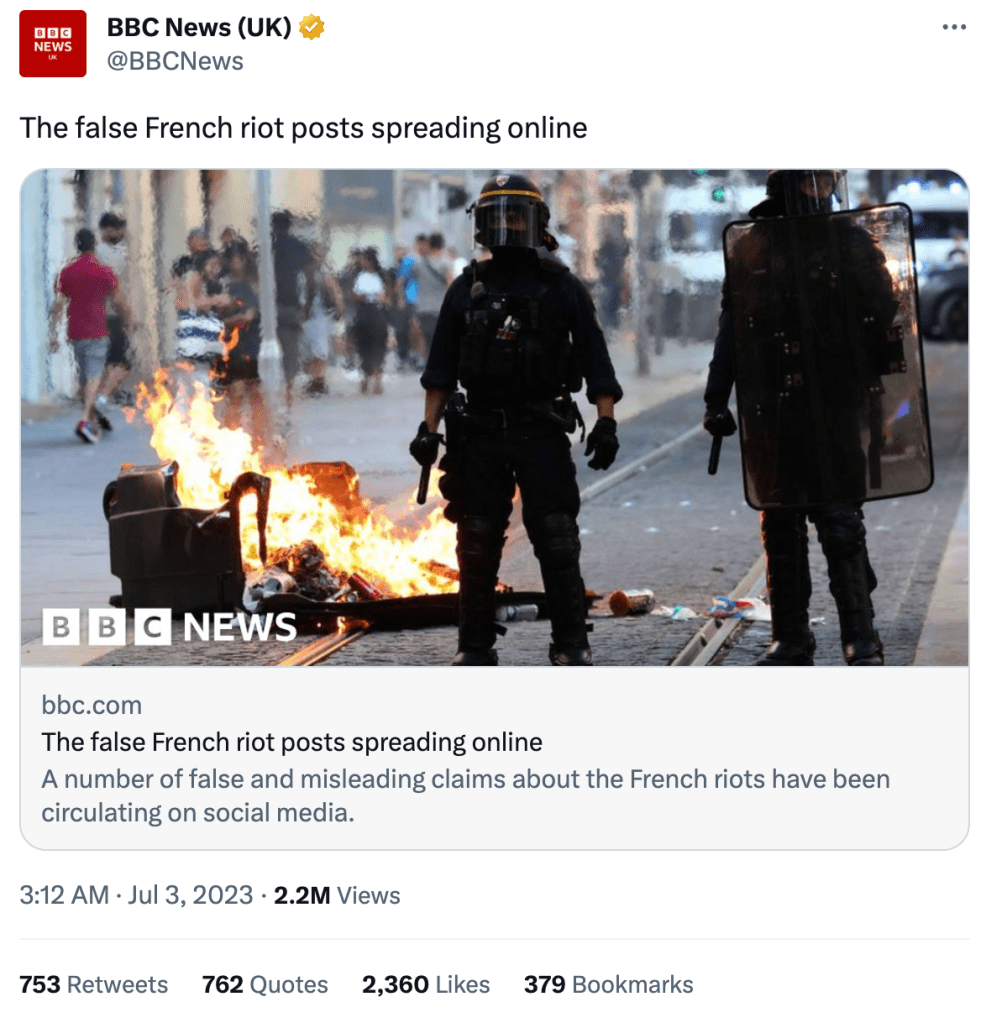
In yet another controversial twist, BBC News(UK) has found itself at the center of a heated Twitter storm. Accustomed to being exposed for spreading COVID and vaccine fake news, the network is now being ruthlessly ratioed for its claims regarding the French riots.
Let’s dive into the drama and witness how Twitter users are turning the tables on the BBC.
The tweet that sparked the outrage, posted by the BBC News account 24 hours ago, boldly declared, “The false French riot posts spreading online.” This seemingly innocent statement unleashed a frenzy of over 5,200 comments, while a meager 2,300 likes trickled in. Clearly, the BBC had struck a nerve, and the Twitterati were not about to let it slide.
However, it seems that the BBC’s own ammunition fell flat. The network’s investigative efforts yielded examples that failed to convince its skeptical audience. One such instance involved a striking image of young men driving a French police van, which was promptly exposed as a still from a French film. Twitter users were quick to dismiss this weak evidence, suggesting it had little impact in the realm of social media.
The BBC’s second example fared no better. A footage showing cars falling from a multi-story car park was swiftly recognized as a scene from another film. This blunder on the part of the BBC investigators further undermined their claims, leaving Twitter users to question their credibility.
But the irony of the situation was not lost on the Twitterverse. Users wasted no time in reminding the BBC of its own checkered history of spreading fake news and disinformation over the past three years, affecting millions worldwide. The network’s credibility had come into question, and Twitter was eager to hold them accountable.
Twitter users capitalized on the opportunity to express their skepticism towards the BBC. One user, @YerFavColonizer, cleverly pointed out that the BBC’s article did not actually claim that the riots themselves were false. Instead, they emphasized that it focused on false attributions of videos circulating online. This astute observation garnered widespread support, striking a chord with those scrutinizing the network’s narrative.
Another user, @therealmissjo, raised the stakes by asserting that while some footage may be misattributed, the French riots were an undeniable reality, causing extensive damage. They chastised the BBC for potentially downplaying the severity of the situation, urging the network not to marginalize what was actually happening.
Amidst the online backlash, a user by the handle @Wasclywabit directly questioned the BBC, asking, “How does it feel to betray your people by doing the bidding of WEF?” This pointed comment underscored the growing mistrust in mainstream media and its alleged allegiance to external influences.
User @AJ01396773 minced no words, directly accusing the BBC of spreading false riot posts and claiming to have caught them spreading misinformation multiple times in the past 24 hours. The network was finding itself on the receiving end of the same accusations it had leveled against others.
Even @EuRollout chimed in, questioning why anyone should believe the BBC when it published articles portraying Antifa as peaceful. The skepticism towards the network’s credibility was palpable.
In the face of the relentless Twitter storm, one user, @ConnellJago, succinctly asked, “Does anyone believe the BBC on anything?” This simple yet potent question resonated with many, encapsulating the widespread doubt surrounding the network’s reliability.
As the social media battle rages on, the BBC finds itself caught in the crossfire. Twitter users, armed with evidence and a keen eye for deception, are exposing the network’s shortcomings. In this clash of narratives, it remains to be seen whether the BBC will address the mounting criticism and regain the trust of its audience, or if this latest controversy will further erode its credibility. As Twitter continues to serve as a platform for exposing misinformation in real-time, the spotlight shines brightly on news organizations, demanding accountability and transparency.
 The Daily Netizen