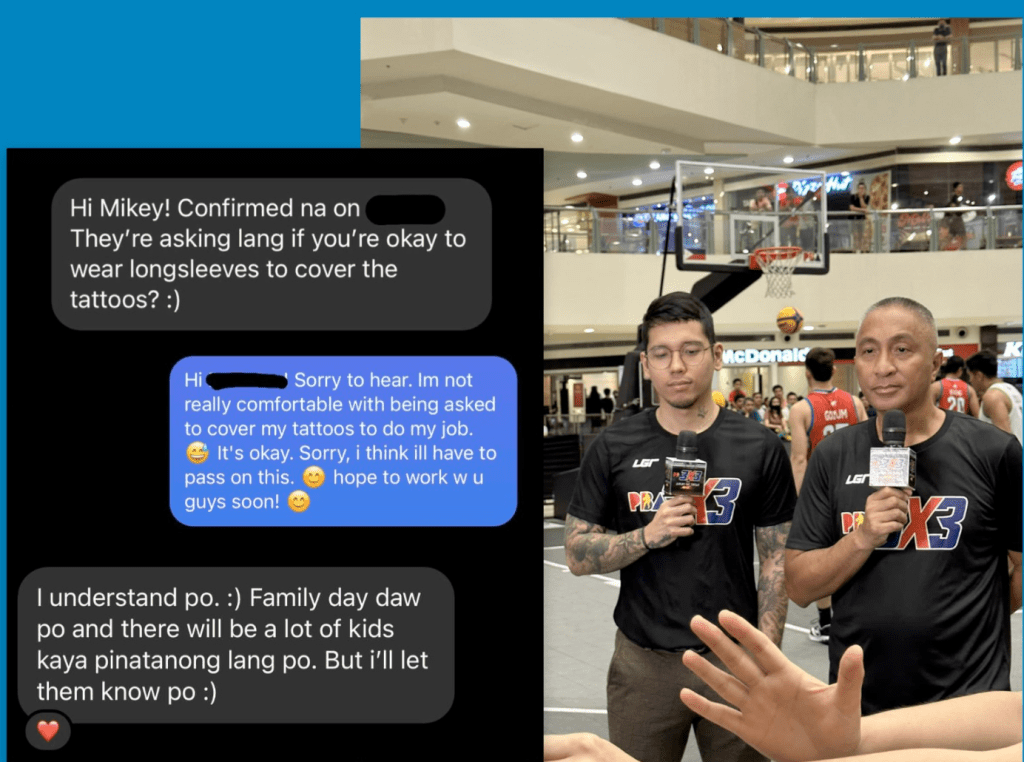
With self-expression manifesting in diverse ways, tattoos have become a medium for individuals to display their distinctiveness and individuality.
However, even as the acceptance of tattoos grows across different societies, there are places where these artistic expressions still face stigmatization and prejudice. The Philippines is one such country where tattoos often evoke mixed reactions, and sports anchor Mikee Reyes recently found himself at the center of this discussion.
Reyes took to social media to express his frustration after being asked to cover his tattoos with long sleeves for an event. Sharing a screenshot of the conversation, he questioned the notion that his inked skin made him a “bad influence to the kids.” Reyes eloquently raised the point that his tattoos could actually serve as a means to impart positive lessons to children.
“Pero I assume kilala niyo naman sino kinukuha niyo? You couldve just told me na ang attire is formal or semi formal, and I wouldn’t look into it. Susunod naman ako,” Reyes writes, as he shared a screenshot of his conversation with an unnamed individual.
“My tattoos make me a bad influence to the kids? Pano kung may ma-impart pala sana akong maganda sa kanila?” he adds.
The incident sparks a conversation about the prevailing negative perception of tattoos in the Philippines. Despite the country’s rich history of indigenous tattoo artistry, tattoos have long been associated with criminality, rebellion, or a disregard for tradition.
This outdated perspective has lingered, resulting in tattooed individuals facing judgment and assumptions about their character. Even as tattoos become more mainstream globally, there is still a journey ahead to shift these deep-seated attitudes in Philippine society.
However, it’s crucial to remember that tattoos don’t define a person’s worth or morality. The art on one’s skin is merely an external representation of their inner beliefs, experiences, and passions. Just as books shouldn’t be judged by their covers, people with tattoos deserve to be understood beyond their ink.
Our TAKE on this issue
Businesses that hire sports anchor Mikee Reyes to promote their services or appear at their events, especially those attended by children, are within their rights to ask him to cover his tattoos. While Reyes certainly has the right to have and proudly display his tattoos as a form of self-expression, the businesses also have the responsibility to consider their target audience and the impact their choices might have, especially when dealing with younger viewers.
Children are impressionable and often look up to public figures like sports anchors, and their appearances can leave a lasting impact on young minds. Businesses that cater to children, such as those providing services or hosting events for kids, need to maintain an image that aligns with their values and audience expectations. Tattoos, while a form of self-expression, can sometimes be seen as controversial or inappropriate by certain demographics, including parents who might be concerned about their children being exposed to content they consider unsuitable.
This is not about denying Reyes the right to showcase his tattoos; rather, it’s about businesses making informed decisions to ensure that their events and promotions are in line with their branding and target audience. Just as Reyes has the freedom to express himself through his tattoos, businesses have the freedom to choose how they want to present themselves to their customers, especially when children are involved. Balancing individual expression with the need to provide a suitable and respectful environment for all attendees is a challenge that businesses often face, and their decisions should be respected as well.
 The Daily Netizen