Amidst the abundance of information, the proliferation of misinformation, fake news, and dubious narratives has emerged as a pressing concern.
When such misinformation emanates from prestigious institutions, it’s even more disheartening.
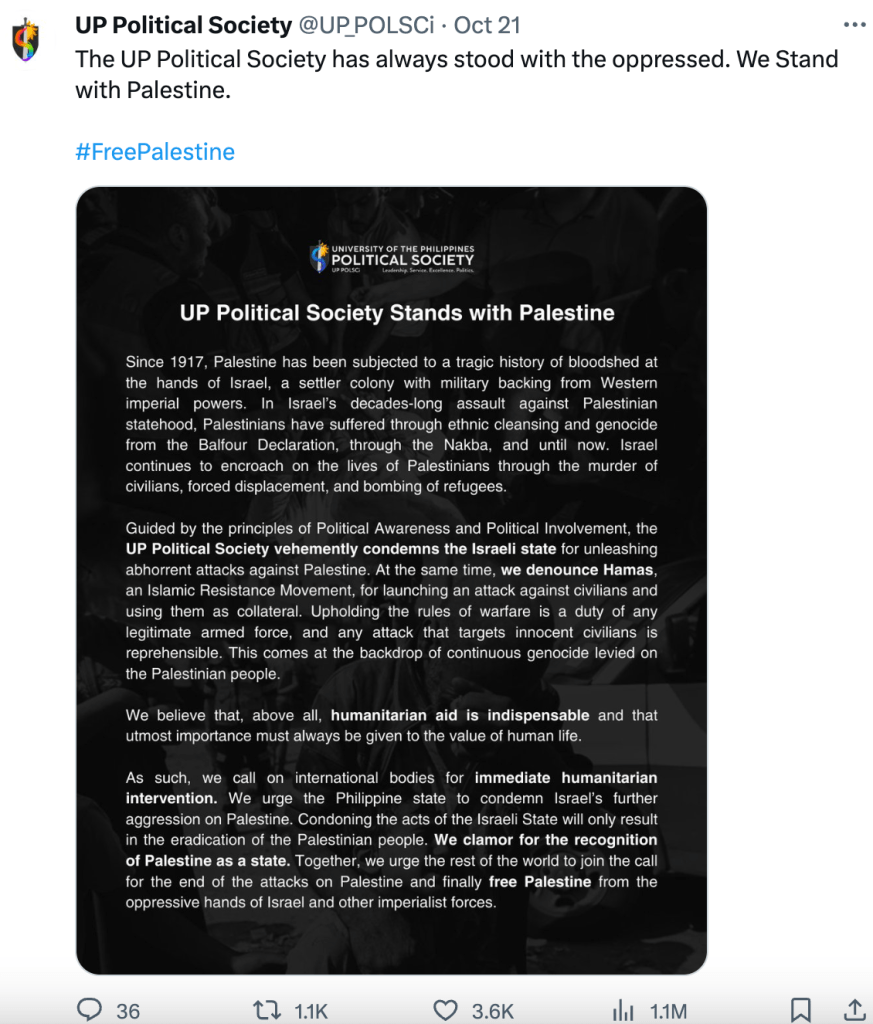
The University of the Philippines’ Political Society (UP PolSoc) has come under scrutiny for its stance on the Israel-Hamas conflict.
In a world where facts matter more than ever, it’s crucial to dissect such claims critically.
In an October 21 post, UP PolSoc, representing one of the Philippines’ top universities, made a bold statement regarding the ongoing Israel-Hamas war.
They posted, “The UP Political Society has always stood with the oppressed. We Stand with Palestine. #FreePalestine.”
While supporting a cause is a fundamental right, the legitimacy of the information used to support that cause must be scrutinized.

The opening lines of their statement, “Since 1917, Palestine has been subjected to a tragic history of bloodshed at the hands of Israel, a settler colony with military backing from Western Imperial powers,” are indeed worth examining.
- Historical Accuracy: The statement’s claim that “since 1917, Palestine has been subjected to a tragic history of bloodshed at the hands of Israel” raises eyebrows. There was no independent Palestinian state in existence in 1917. The region was under the control of the Ottoman Empire, which officially ended in 1922.
- Historical Timeline: The statement fails to acknowledge that the Ottoman Empire signed the Armistice of Mudros in 1918, effectively marking the beginning of its disintegration. It was only after World War I that significant changes occurred in the region.
- Foundation of Israel: Perhaps the most crucial historical inaccuracy is the assertion that Israel has been responsible for the suffering in Palestine since 1917. The state of Israel was not established until May 14, 1948. This makes it impossible for Israel to have inflicted suffering on Palestine in the manner described.
This discrepancy between historical facts and the claims made in the statement raises concerns about the accuracy of the information presented. Inaccurate historical accounts can perpetuate biases and prejudices, and in this case, it may be seen as a form of misinformation and, at worst, as veiled anti-Semitism.

It’s essential to maintain a well-informed and fact-based discourse on complex geopolitical issues like the Israel-Hamas conflict. Misinformation not only misrepresents history but can also breed misunderstanding and hate.
In light of this, there are several questions UP PolSoc and its members should consider addressing:
- Settlers: Define the terms “settlers” or “settler colony” when describing Israelis. These terms are often loaded and merit clear explanations.
- State of Palestine: When was the so-called State of Palestine officially established, and under what circumstances?
- Claims of Ethnic Cleansing: Provide credible evidence for the claim of “ethnic cleansing and genocide” stemming from the Balfour Declaration.
- Pre-1922 Occupants: Who occupied the region before the Ottoman Empire’s official end in 1922?
- Initiation of Conflict: Who initiated the conflict that unfolded in October, and what led to it?
- Civilian Casualties: Report on the number of foreign nationals killed by Hamas and Palestinians during the recent conflict.
- Intellectual Responsibility: Lastly, the question remains – how responsible is it to disseminate information without factual substantiation?
Misguided or incorrect information can breed misunderstanding and polarization, hindering the pursuit of peace and justice in global conflicts.
It is incumbent on organizations like UP PolSoc, especially those representing esteemed academic institutions, to provide accurate and well-researched information in their discourse on complex issues.
 The Daily Netizen