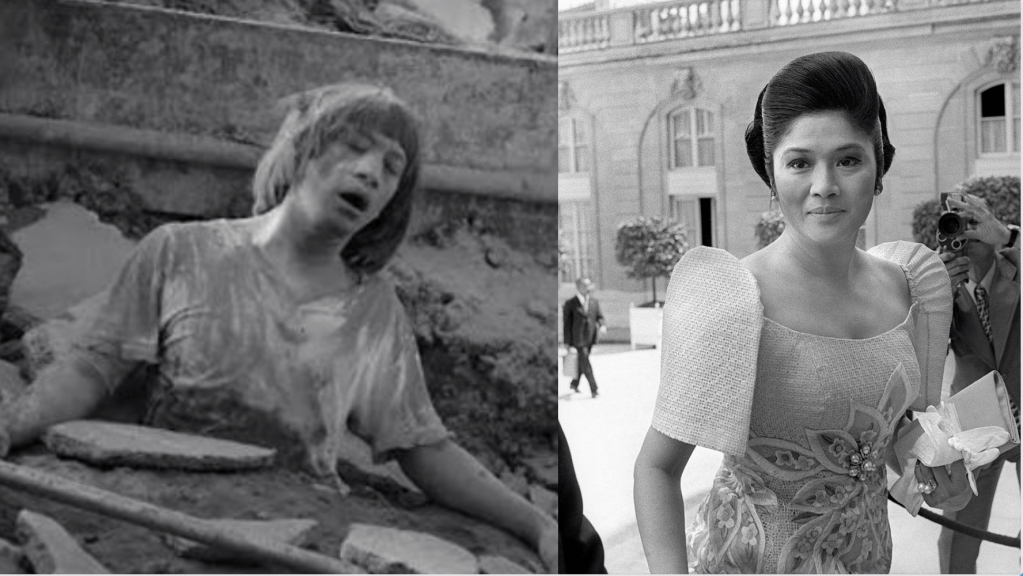
In the heart of the Philippines’ capital, Manila, lies a haunted edifice, bearing witness to a dark chapter in the nation’s history.
The Manila Film Center, a grandiose structure envisioned to be the centerpiece of the Manila International Film Festival, now stands as a symbol of both the country’s ghostly folklore and the corruption and excesses of former First Lady Imelda Marcos.
A Dream Turned Nightmare
The story began in 1981 when the extravagant and ambitious Imelda Marcos, sought to make Manila the cultural center of the East, rivaling the prestige of France’s Cannes Film Festival. The Philippines was strategically positioned to become an international marketplace for films, and thus, the Manila International Film Festival was conceived. The grand vision included the iconic Manila Film Center, designed by architect Froilan Hong and conceptualized by Ramon M. Ignacio.
Inspired by the Parthenon in Athens, the Film Center was initially planned to encompass multiple facets, such as a 360-degree theater, a film lab, and film archives. To ensure the success of this grand endeavor, Imelda enlisted the support of UNESCO experts in 1981. With a budget of $25 million, an ambitious timeline, and around 4,000 laborers working in three shifts around the clock, the stage was set for a disastrous outcome.
Tragedy Strikes: Entombed Under Cement
On the fateful night of November 17, 1981, at around 3 a.m., disaster struck as scaffolding on the fourth floor of the Film Center collapsed, trapping workers in quick-drying cement. The rush to complete the building led to hasty construction practices, with layers of cement poured on each floor without allowing them to dry properly.
Media blackout ensued as a blanket of security was imposed by the Marcos regime, preventing rescuers and ambulances from reaching the site for nine agonizing hours. By then, it was too late, with at least 168 workers buried beneath the solidified cement. Jackhammers were later employed to taper off exposed bodies and continue construction as if nothing had happened.
The Marcoses might have used their nearly-absolute political power to secure a news blackout and punish anyone who spoke about the tragedy. Only after the Conjugal Dictatorship collapsed did public figures, such as the late multi-awarded director Lino Brocka, finally speak about the tragedy.
“The ex-first lady, Imelda, took pride in the fact that they could finish the building in just 70 days. So, they worked here day and night for about 70 days. A week before the opening, the third floor collapsed,” Brocka said.
Brocka also revealed that Imelda made a “controversial decision— “Go ahead and bury them,” he said, quoting the former First Lady. “They were all buried, instead of giving them the time to get them out, because the cement was hardening. Right away, there were pictures published, showing people who were half-buried in the cement,” he added.
Brocka also shared that some of the half-buried workers “were cut into pieces.” “And some of them were, I think, still alive, but it was not possible to get them out because the cement had already hardened by then.”
Haunted by Tragedy: The Ghostly Legacy
Despite the horrors of that night, the Film Center’s opening took place as planned on January 18, 1982. International press lauded the event, but unbeknownst to the visitors, they walked on the remains of hundreds of Filipino workers who had been entombed in the cursed building.
Rumors began to circulate, adding to the eeriness of the place. A fortune-teller allegedly warned Imee Marcos, the first daughter, that she would die if she set foot in the building. Efforts to cleanse the site included exorcism, pagan rites, Catholic rites, and Chinese rituals. Despite these attempts, eerie experiences plagued those involved in the festival, from strange smells to ghostly encounters.
Months later, Betty Benitez, who ordered the construction to continue after the tragedy, died in a freak car accident. Many believed it was the vengeful spirits of the deceased workers. A medium claimed the spirits said, “Betty is with us.”
The Aftermath: Curse and Controversy
While the Manila Film Center showcased films from around the world and facilitated deals for Filipino films, the festival suffered a financial setback. Prime Minister Cesar Virata disapproved a $5 million subsidy meant for the event’s support. To keep the center afloat, Imelda created an agency that allowed explicit films to be shown without censorship, inviting criticism and controversy.
After the Marcos regime fell, the building was abandoned due to structural issues following the 1990 earthquake. It was eventually rehabilitated and leased to various entities, including the Amazing Philippines Theater, which faced its own share of unexplainable accidents. The ghosts of the Film Center continued to haunt the area.
Today, the Manila Film Center stands as both a reminder of the country’s haunted past and a symbol of the Marcos dictatorship. Yet, the spirits of the past linger, and the legacy of this haunting structure remains an indelible part of Philippine history, a chilling testament to the corruption and ambition that once gripped the nation.
 The Daily Netizen