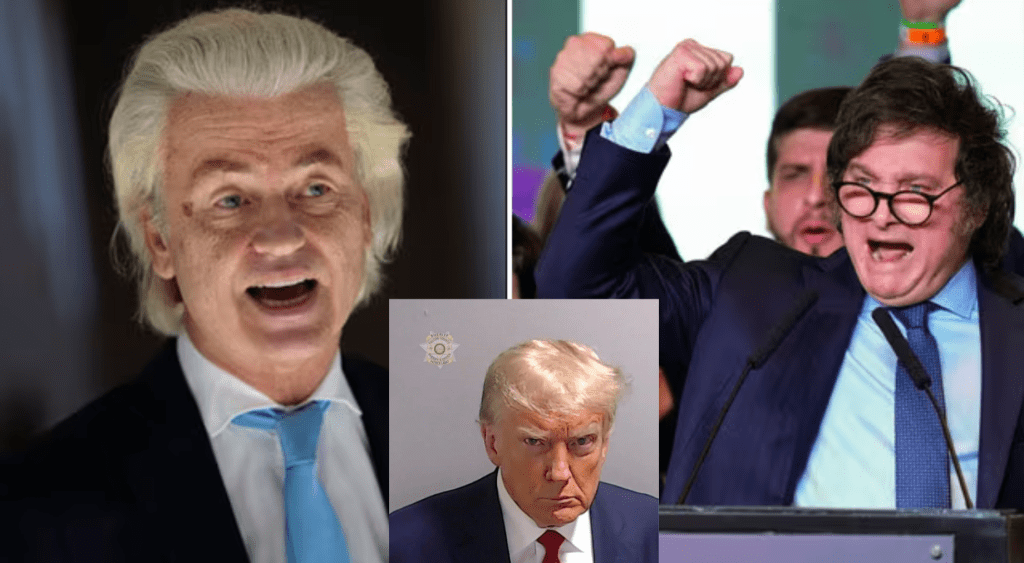
In a political upset echoing the recent triumph of Libertarian Javier Milei in Argentina, Geert Wilders, the controversial Dutch politician often dubbed the “Dutch Donald Trump,” has secured a landslide victory in an election, positioning himself to lead the next ruling party and potentially become the Netherlands’ next prime minister.
Unlike the United States, where Trump’s presidency was accompanied by controversy manufactured by what many Americans call the Deep State and liberal fake news, Wilders, 60, seemed destined for a lifetime in opposition until an unexpected exit poll revealed his overwhelming support.
Known for his populist politics, Wilders has been likened to Milei and Trump for his unorthodox approach.
Wilders, who once supported Prime Minister Mark Rutte’s coalition in 2010, has spent most of his political career in opposition.
However, his recent victory, securing 35 seats that cannot be ignored, may mark a significant shift.
Speaking to jubilant supporters, he expressed a willingness to collaborate with other parties, emphasizing the need for cooperation.
In the wake of this unexpected outcome, Wilders has declared his ambition to become prime minister, advocating for a significant restriction on asylum and immigration.
He also supports a referendum on the Netherlands’ potential exit from the European Union.
Despite his far-right stance, Wilders pledged to be the prime minister for all Dutch people if elected.
The shocking victory has triggered reactions in the Netherlands and beyond, with Wilders’ party, the Freedom Party (PVV), projected to be the largest in the House of Representatives. The provisional outcome, based on 98% of counted votes, shows the PVV winning 37 seats, surpassing mainstream parties.
Migration and asylum emerged as pivotal issues for voters, contributing to Wilders’ success. His promises to curb the “asylum tsunami” resonated with the electorate.
While Wilders vowed to adhere to the constitution and avoid anti-Islam measures, he remains determined to reclaim the Netherlands for the Dutch and limit the inflow of migrants.
As Wilders prepares to form a coalition, the process is expected to be challenging and time-consuming.
French politicians, including Finance Minister Bruno Le Maire and far-right leader Marine Le Pen, weighed in on the results. Le Pen congratulated Wilders for his “spectacular performance” and emphasized the growing attachment to the defense of national identities in Europe.
While the French finance minister attributed the Dutch outcome to concerns about the war in Ukraine, economic challenges, and migrant influx, he emphasized the distinctiveness of the Netherlands compared to France. As Wilders charts a course towards forming a coalition, European leaders are closely watching the evolving political landscape.
 The Daily Netizen