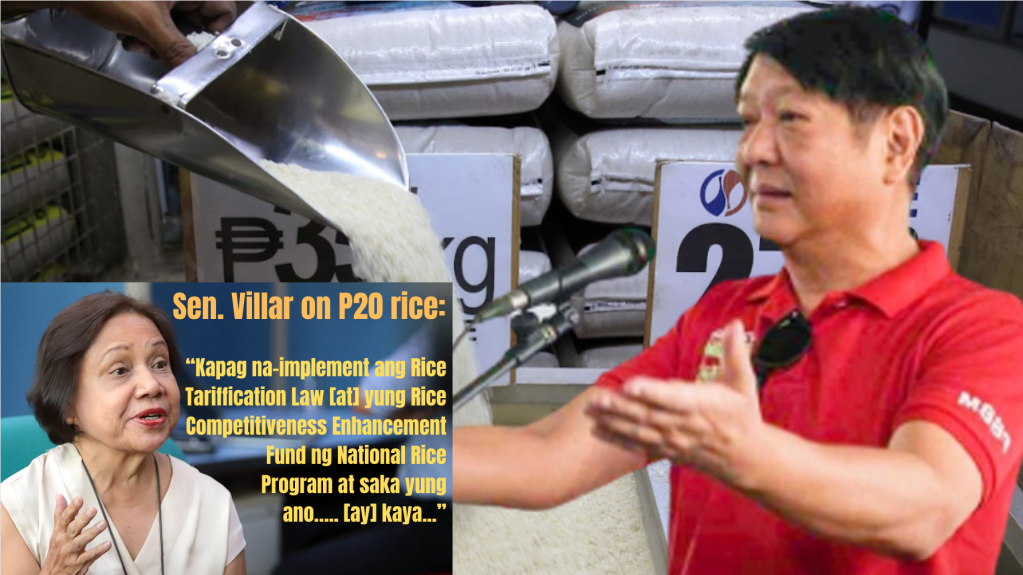
Senator Cynthia Villar has floated the idea of achieving P20 per kilogram of rice by 2024, aligning herself with President Bongbong Marcos’s dubious promise during the 2020 election campaign.
This sudden about-face comes after Villar had previously dismissed the feasibility of such a low price, raising concerns about the sincerity of her stance and her seemingly opportunistic alignment with the Marcos administration.
“Kapag na-implement ang Rice Tariffication Law [at] yung Rice Competitiveness Enhancement Fund ng National Rice Program at saka yung ano….. [ay] kaya,” Villar said like a true Marcos fanatic and ally.
Villar, who chairs the Senate committee on agriculture, food, and agrarian reform, touted the potential success of the Rice Tariffication Law and the Rice Competitiveness Enhancement Fund of the National Rice Program, emphasizing the need for proper implementation.
“Kaya lang ang problema natin ay yung (Our problem is) implementation… if they will implement it,” she said.
This echoes her previous rhetoric but brings into question whether these statements are mere political posturing rather than genuine commitment.
“Kailangan mura ang puhunan. Kaya may perang binigay sa Landbank at Development Bank of the Philippines. Kaso kung hindi nila ‘yun ibibigay sa farmers ay mahihirapan tayo to be competitive. Pero kung maganda ang implementation of the law we can do it,” she explained.
The senator highlighted the necessity of mechanization, training for farmers, and access to better seeds to achieve lower rice prices.
Yet, Villar’s credibility is undermined by her flip-flopping on the issue, as records indicate that she contradicted her recent optimism in July 2022, claiming that a P20 per kilo rice was difficult to attain and suggesting P32 per kilo as a more realistic target.
The question arises: What compelled Senator Villar to backtrack on her previous stance, especially at a time of escalating inflation?
Her sudden reversal prompts skepticism about her motivations and raises doubts about her allegiance to the welfare of Filipino consumers versus political expediency.
It can be recalled that last year, Villar cited the cost of converting palay to rice, stating, “Hindi. Kasi ang cost natin [palay] P11.50 to convert it into rice times 2. So P11.50, P23 na lang e paano ‘yung pag-transport, yung kita ng farmers, and all that. So siguro reasonable P30 plus.”
However, this explanation fails to address the stark contrast between her recent optimism and her earlier, more realistic assessment.
Senator Villar’s wavering position on the price of rice raises serious questions about her commitment to the welfare of Filipino consumers and underscores the apparent political opportunism at play.
As she aligns herself with the Marcos administration’s questionable promises, critics are left wondering whether Villar’s actions serve the public interest or merely mirror her political affiliations.
 The Daily Netizen