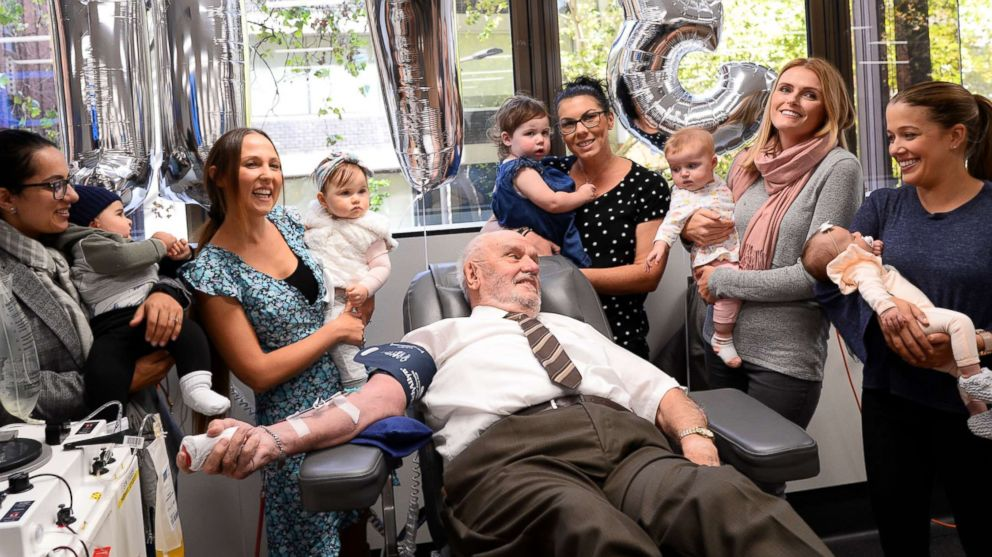
Amidst a landscape frequently dominated by self-interest, certain individuals exemplify acts of pure compassion and selflessness.
Meet James Harrison, affectionately known as the ‘man with the golden arm,’ whose extraordinary journey has saved the lives of over 2.4 million babies.
Harrison’s remarkable story began at the tender age of 14 when he underwent major chest surgery.
It was blood donations that saved his life during this critical time, inspiring a solemn pledge to become a blood donor himself, News18 reported.
Little did he know that this commitment would lead to a legacy that transcends generations.
Over the span of 60 years, Harrison donated blood almost every week, making an invaluable contribution to the Australian Red Cross Blood Service.
His journey took an extraordinary turn when doctors discovered a unique quality in his blood—a rare antibody that could combat a life-threatening condition known as rhesus disease.
Rhesus disease poses severe risks when a pregnant woman with rhesus-negative blood carries a baby with rhesus-positive blood.
Harrison’s blood, however, emerged as a source of hope. The antibodies discovered in his blood became instrumental in the creation of an injection called Anti-D, a medical breakthrough that effectively addresses rhesus disease.
Since 1967, over three million doses of Anti-D have been issued, benefiting more than 2 million women.
Anti-D, crafted from Harrison’s antibodies, serves as a preventive measure against the development of RhD antibodies in pregnant women with rhesus-negative blood.
Harrison’s profound influence is clear in the numerous lives he saved, including those of his own family. Even his daughter, touched by her father’s extraordinary gift, received the Anti-D vaccine, securing the birth of a healthy grandson.
Harrison’s altruistic commitment to blood donation and the subsequent identification of his distinctive antibodies have proven to be a transformative force for the medical community.
Although the origins of his rare blood type remain uncertain, doctors suspect that the transfusions he received during his adolescence might be the key.
Over six decades, Mr. Harrison made a remarkable 1,173 blood donations, with the pivotal antibody for the vaccine extracted from his blood plasma.
In 2018, his final donation marked the conclusion of an era as he reached the maximum donor age in Australia.
The breakthrough in treating rhesus disease, pioneered by Australian geneticists in the 1960s, hinged on Harrison’s unique combination of RhD negative blood and Rh positive antibodies.
His body’s exceptional ability to produce these antibodies in high concentrations made him an unparalleled donor, a rarity globally.
According to Jemma Falkenmire from the Australian Red Cross Blood Donor Service, “His body produces a lot of them, and when he donates, his body produces more,” as reported by NDTV.
Harrison’s extraordinary journey, rooted in gratitude for a life-saving transfusion at the age of 14, continues to be a source of inspiration for generations, underscoring the profound impact that one person’s dedication can have on changing the world.
 The Daily Netizen