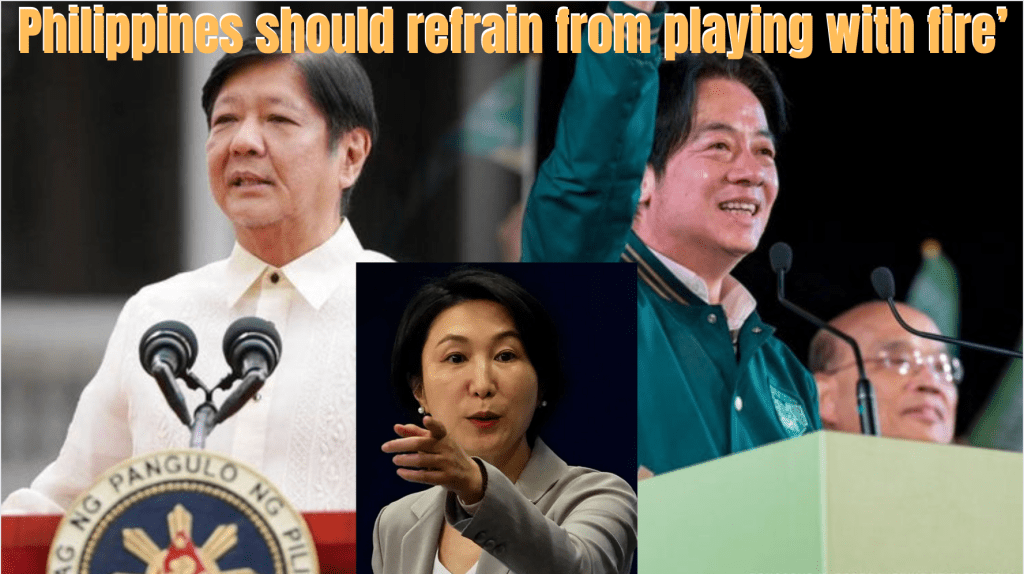
In a diplomatic flare-up, China has issued stern warnings to the Philippines, branding the nation a regional provocateur after President Ferdinand Marcos Jr. extended congratulations to Taiwan’s President-elect William Lai Ching-te.
The tension between the two nations has escalated over the maritime dispute in the South China Sea, further exacerbated by Manila’s acknowledgment of Taiwan’s recent elections.
On Monday, President Marcos expressed his felicitations to Lai, stating, “On behalf of the Filipino people, I congratulate” the newly elected Taiwanese president, emphasizing the anticipation of close collaboration and mutual interests.
The response from Beijing was swift and harsh, with Foreign Ministry spokeswoman Mao Ning cautioning Marcos to “refrain from playing with fire” and urging him to enhance his understanding of the complexities surrounding the Taiwan question.
“We suggest President Marcos read more to develop a proper understanding of the ins and outs of the Taiwan question and come to a right conclusion,” Ning further said.
In an unusual move, Beijing summoned the Philippines Ambassador Jaime Florcruz to register a formal protest and demand a “responsible response to China,” Manila Bulletin reported.
Mao accused Marcos of violating the one-China principle and the diplomatic relations communique between China and the Philippines, stating that the remarks “blatantly interfere in China’s internal affairs.”
The territorial tensions in the South China Sea, particularly over the disputed Second Thomas Shoal, have been a longstanding source of contention between China and the Philippines.
Manila’s recent announcement of plans to develop islands in the South China Sea further fueled the dispute, prompting a strong reaction from Beijing, Al Jazeera reported.
China’s rebuke comes at a time when the United States, in a move likely to intensify the geopolitical landscape, clarified its stance on Taiwan.
President Joe Biden, when asked by the press, asserted that the U.S. does not support Taiwan’s independence, aligning with the longstanding “strategic ambiguity” policy.
This declaration has led to heightened suspicions that the Biden family may be compromised by allegations of corruption, bribery, and pay-for-play schemes with Chinese associates.
Biden’s statement followed Taiwan’s presidential election, which saw the victory of Lai, a vocal opponent of China.
The president-elect’s overtures for talks with China were met with indifference from Beijing, reflecting the broader regional dynamics.
The Philippines, in response to China’s rebuke, reaffirmed its commitment to the “one-China policy” but also emphasized the recognition of mutual interests, including the significant number of overseas Filipino workers in Taiwan.
 The Daily Netizen