
In the wake of the heated exchange between Philippine President Ferdinand Marcos Jr. and former President Rodrigo Duterte, where accusations of drug use and being “bangag” (high) were traded, Marcos pointed to the term “Fentanyl” to explain Duterte’s supposed chaotic mental conditions.
This revelation triggered a surge in online searches, making “Fentanyl” the top trending term on Google, followed by “people’s initiative” and “Ravens vs Chiefs.”
The increased interest in Fentanyl among Filipinos may stem from the fact that this term is relatively unfamiliar to many in the country.
However, the global impact of Fentanyl is significant, as evidenced by the alarming statistics from the United States.
In 2021 alone, over 106,000 deaths were attributed to Fentanyl, making it a pressing issue that has now captured the attention of the public.
The controversy between Marcos and Duterte escalated as Marcos, in his first public rebuke of the former leader, suggested that Duterte’s mental state might be influenced by Fentanyl use.
Duterte had previously admitted to using Fentanyl, a potent opioid medication, to alleviate migraines and spinal pains during his term.
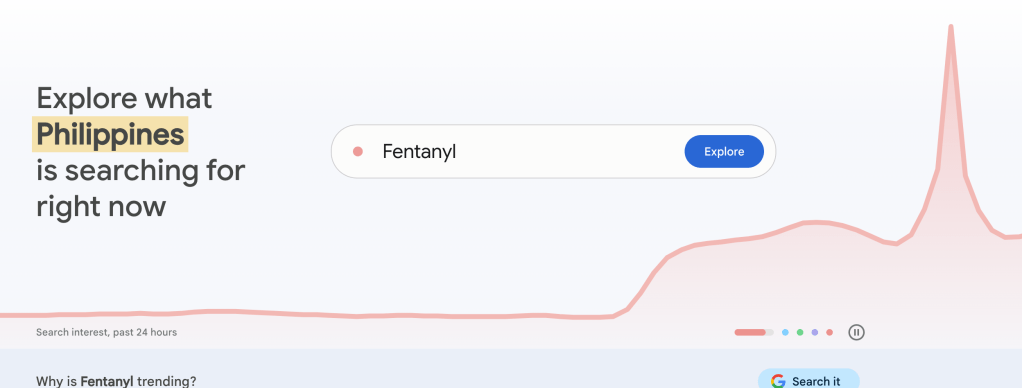
While Fentanyl is a common term in U.S. political discourse, it may be relatively new to many Filipinos.
The U.S. Drug Enforcement Agency (DEA) has reported an evolving crisis with diverse sources of Fentanyl, complicating global efforts to curb its flow.
Notably, the U.S. and China are set to meet to address this issue, marking a significant step in counternarcotics cooperation.
According to the Centers for Disease Control and Prevention (CDC), Fentanyl-related overdose deaths have surged in recent years, reaching over 106,000 in 2021.
Fentanyl, a synthetic opioid up to 50 times stronger than heroin, has become a major contributor to the opioid epidemic.

Its lethality is compounded by its potency, as even small doses can be lethal.
The rise in Fentanyl-related deaths may be linked to a decline in opioid prescription rates and the increasing prevalence of illegally manufactured Fentanyl combined with other drugs.
Here are things you need to know about Fentanyl, which is becoming part of major political discourse in the United States:
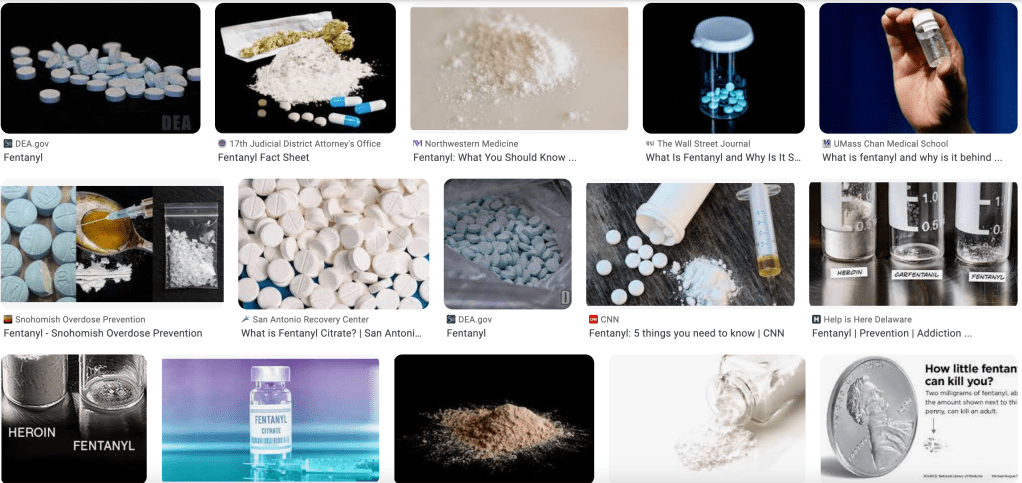
Unlike in the United States, where the term is commonly used in political discourse, the term “Fentanyl” may be new or completely unfamiliar to many Filipinos.
- The US Drug Enforcement Agency (DEA) reported in January 2020 that the flow of fentanyl into the United States had become more diverse by 2019, involving new source and transit countries.
- The increased diversity complicates law enforcement operations and policy efforts to control the flow of fentanyl, with Mexico and China identified as primary source countries. However, India is emerging as a source for finished fentanyl and precursor chemicals, US Drug Enforcement Agency (DEA) reported.
- The US and China, under the Biden administration, scheduled a high-level meeting on January 30 to address the fentanyl crisis. This meeting follows a breakthrough agreement between President Biden and Chinese President Xi Jinping in November, aiming to restart counternarcotics cooperation.
- Fentanyl overdose deaths have been a growing concern, reaching over 106,000 in 2021. In 2022, there were 73,654 deaths, more than double the number in 2019. The year-over-year growth in 2022 marked a smaller increase at 4.3%.
- Fentanyl, a synthetic opioid, is significantly stronger than heroin and morphine, leading to dependency and addiction. Illicit fentanyl is often produced in labs outside the country and smuggled across the US-Mexico border.
- The opioid epidemic initially saw a surge in overdose deaths driven by prescription drugs like Hydrocodone, Oxycodone, Oxymorphone, and Morphine. The approval of pharmaceutical fentanyl in 1998 contributed to the crisis.
- Overdose deaths shifted from prescription opioids to heroin and, eventually, illegally made fentanyl. Drug dealers often mix fentanyl with other substances, increasing the risk of overdose, sometimes without users’ knowledge.
- Fentanyl overdose deaths started rising significantly in 2013, categorized as the third wave of the opioid epidemic. In 2022, fentanyl was responsible for 23 times more deaths than in 2013.
- The rise in fentanyl overdose deaths may be linked to a decline in opioid prescription rates, reformulations of drugs like Oxycontin to curb abuse, and the increasing combination of illegally made fentanyl with other illicit drugs.
- Despite a decline in opioid prescriptions from 2010 to 2020, overdose deaths involving any opioid more than tripled during the same period, indicating the persistent severity of the opioid crisis.
 The Daily Netizen