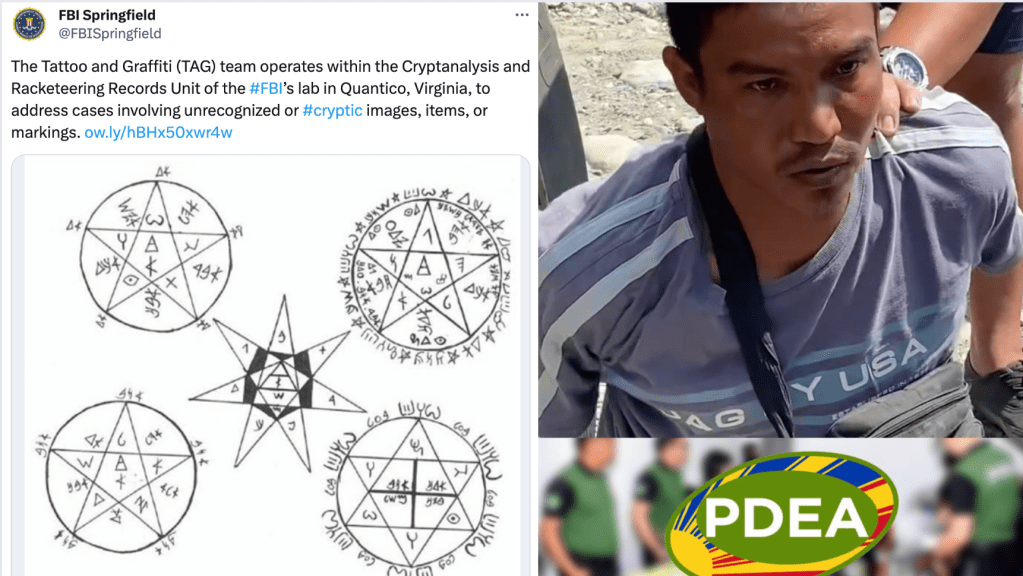
In a recent incident in Ilocos Norte related to a now-viral buy-bust operation, the actions of a female PDEA agent during the questioning of a drug suspect, Jayson Dumlao, have sparked controversy and raised questions about the agency’s protocols.
An unidentified female PDEA agent repeatedly asked Dumlao whether he had tattoos in a badgering manner. The agent even told Dumlao, “relax ka lang,” in what many netizens deemed a sarcastic tone. Her repeated inquiries about the presence of tattoos drew criticism for their discriminatory nature.
A local radio station in Laoag City, which shared footage of the incident, found it necessary to issue a clarification.
They emphasized that the voice in the footage belonged to a PDEA agent, not their reporter, stating, “Our station does not engage in any form of discrimination against individuals with tattoos.”
Now former Ilocos Norte director police Col. Julius Suriben stepped forward to defend PDEA’s actions, attempting to justify the procedure by referencing the FBI’s Tattoo and Graffiti (TAG) team. However, his defense has drawn criticism, with concerns emerging about the application of such methods in the Philippines.
In his defense of the PDEA’s questioning of a drug suspect about the presence of tattoos, Suriben took to Facebook to share what he considered to be relevant information.
He highlighted the existence of the FBI’s “Tattoo and Graffiti (TAG) Team” within the bureau’s Cryptanalysis and Racketeering Records Unit.
Suriben pointed out that TAG data gathering and analysis could be valuable for generating investigative leads and providing operational intelligence to law enforcement personnel, citing a study by experts.
“Law Enforcement Agencies (PNP/PDEA, etc) in the country also practice the same for purposes of crime intelligence only. After the arrest has been made, an interview is being conducted where a law enforcement officer (police/agents etc) has to ask and record distingushing marks of the arrested person such as moles, scars, tattoos, symbols and other identifying marks that will form part of the criminal offender’s record in the database of law enforcement agencies,” Suriben said.
The former police official went on to assert that the procedure is not intended to discriminate against, tag, or label an arrested individual. Instead, it serves the purpose of profiling, which can be utilized for future crime investigations and analysis.
“The recent trending issue in Ilocos Norte appears to be misinterpreted as the initial interview was done on site and published online via fb live. As mentioned above, it is a method used to get the personal details/circumstances of an arrested person. So in the current issue, there’s nothing wrong about it except for the manner, time and place where it was made and the uncontrolled circumstances while it is being done (fb live by the media/bloggers),” he added.
Suriben’s attempt to justify the agent’s aggressive questioning of drug suspect Dumlao about the possibility of having tattoos has sparked significant concerns regarding discrimination and ethical conduct within law enforcement.
Suriben contends that the method is not meant to discriminate, emphasizing the misinterpretation by the public. However, the incident underscores the need for law enforcement officers to strictly observe protocols to avoid public misunderstanding, as evidenced by the public outcry.
Suriben’s comparison between the FBI’s specialized unit and the PDEA’s routine questioning fails to acknowledge a crucial difference: the FBI’s TAG program is designed for investigating organized crime, not the routine drug busts carried out in remote municipalities by the PDEA.
While the FBI’s program is geared towards combating organized crime, it operates within a framework that ensures the rights and dignity of individuals are respected.
To quote the same source Suriben cited: “Organized crime entities involved in such activities frequently use characteristic tattoos and symbols.”
According to the same source: “TAG evaluations have aided contributors in the investigation of gang-related crimes, human trafficking, human and drug smuggling, vandalism, and missing persons cases.”
What does this imply? In essence, this specialized program was established to investigate organized crime entities, as the FBI recognized that such activities often involve distinctive tattoos and symbols.
However, in the case of Dumlao, there is little indication that he has any ties to organized crime or gang activity. With no previous criminal record and no evidence linking him to such activities, the aggressive questioning by the female PDEA agent appears unwarranted and potentially discriminatory.
It is crucial to recognize that while tattoo inquiries may be appropriate in certain cases, such as those involving organized crime where characteristic tattoos and symbols are commonly used, they must be conducted with sensitivity and discretion. Using tattoos as a basis for suspicion without sufficient evidence or context can lead to unjust profiling and violations of individual rights.
By attempting to legitimize the PDEA’s tactics with a flawed comparison, Suriben inadvertently exposes the shortcomings of law enforcement’s approach to profiling and interrogation.
- Remember when former Senator Antonio Trillanes demanded that Paolo Duterte reveal his tattoo? Trillanes alleged that the presidential son was affiliated with a drug triad or a Chinese organized crime group, and he claimed that Duterte’s ‘secret’ tattoo would provide evidence of these connections.
Furthermore, the dismissive tone of the PDEA agent’s interrogation, captured in the video as she repeatedly badgered Dumlao, underscores a troubling lack of sensitivity and professionalism.
Suriben’s defense of this behavior as a standard procedure for crime intelligence only serves to perpetuate the notion that individuals with tattoos are inherently suspicious—an outdated and discriminatory stereotype that has no place in modern law enforcement.
As law enforcement agencies grapple with issues of trust and accountability, it is imperative that they prioritize respect for individual rights and dignity in their investigative practices.
 The Daily Netizen