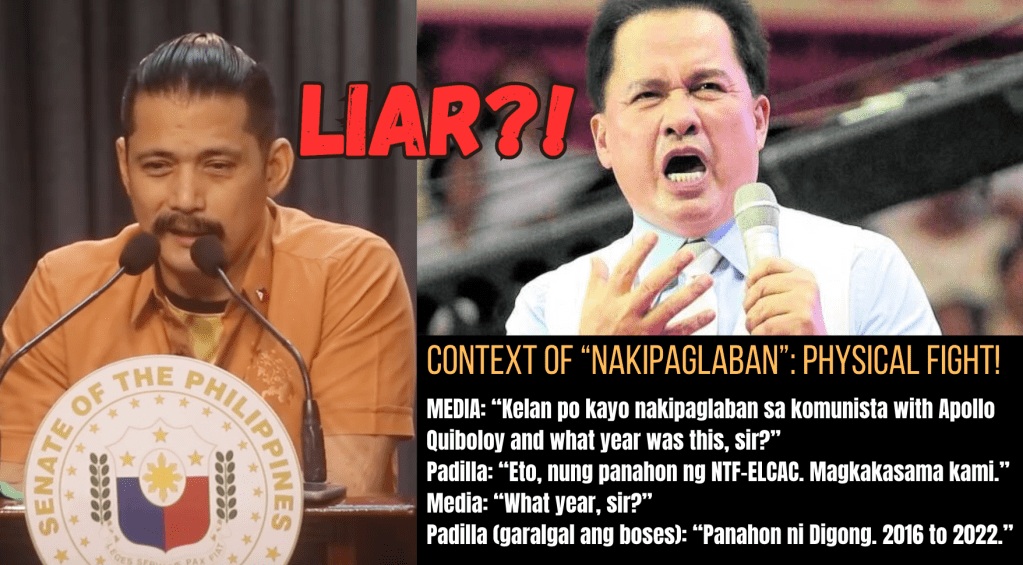
Senator Robin Padilla’s endeavor to rally support against the contempt order targeting cult leader and FBI most wanted Apollo Quiboloy suffered a significant setback.
What began with the backing of five senators now finds itself with only four supporters, sparking speculation about the shifting allegiances within the Philippine Senate.
Padilla’s dwindling support also casts doubt on his assertion that Quiboloy is a hero for fighting against communism.
“Hindi deserve, para sa mga mata ko, na ang isang taong tingin kong bayani sa pakikipaglaban niya sa komunista, na naging kasama ko, e ganitong klase, papayagan ko maiskandalo? Teka muna,” Padilla told the media.
However, the actor-turned-politician was either exaggerating or lying, as he failed to provide proof that Quiboloy actually fought against the communists in the countryside.
When Padilla was specifically asked to cite the year when the cult leader actually fought physically against the communists, Padilla mentioned NTF-ELCAC (National Task Force to End Local Communist Armed Conflict), a task force branded by the previous Duterte administration as anti-communist and with red-tagging as one of its main weapons against critics and political opponents.
“Panahon ni Digong… 2016 hanggang 2022,” he said when pressed to cite the year.
After seemingly caught in his lies or exaggeration, Padilla went on to try to filibuster and resorted to his usual tactic of equating his cinematic roles with his own personal struggles.
This is not the first time the neophyte senator did this trick, as he also talked about his life as an actor vis-a-vis fighting against some unnamed nemesis in his sneaky attempt to tell Quiboloy accusers to show their faces during a previous senate hearing.
Contradicting Padilla’s narrative, there is a wealth of photographic, documentary, and testimonial evidence suggesting that Quiboloy’s close ally, former President Rodrigo Duterte, may have had strong ties with communist guerrillas during his tenure as Davao mayor.
This contradiction calls into question the credibility of Padilla’s assertion and underscores the need for substantiated claims in the political arena.
The withdrawal of Senator Joseph Victor “JV” Ejercito’s support underscores the fragile nature of Padilla’s coalition.
Ejercito’s decision, prompted by mounting allegations of sexual abuse and trafficking against Quiboloy, highlights the gravity of the accusations and their impact on political alliances.
“I initially signed the objection letter initiated by Padilla in consideration of procedural practicality. But after careful review of the facts, witness testimonies, and additional information, such as the allegations of rape during the last committee hearing, I have decided to withdraw my signature today,” Ejercito stated, highlighting the gravity of the accusations.
Beyond the immediate implications for Quiboloy’s case, this development serves as a litmus test for the Senate’s allegiance amid shifting political dynamics.
With Duterte positioning himself as a prominent opposition leader against the administration of President Bongbong Marcos Jr., Padilla’s struggle to garner support highlights the complexities of political allegiance and the evolving landscape of Philippine politics.
Padilla’s quest to secure the necessary votes reflects the delicate balance of power within the Senate.
As he seeks to sway additional senators to his cause, the outcome of this battle could have far-reaching consequences for both Quiboloy and the political landscape of the Philippines.
Meanwhile, Padilla faces an uphill battle as he endeavors to rally additional support before the March 12 deadline.
With only four senators backing his cause, Padilla’s efforts hang in the balance, underscoring the intricacies of Senate dynamics and the shifting political landscape in the Philippines.
“Kailangan ko pa ng tatlo. May mga nakausap na ako na sa mga napakagandang paliwanag nila, tinatanggap ko na hindi sila pumirma. At ‘yan ang mga bagay na ikinatutuwa at ikinalulungkot. Siyempre ikinatuwa dahil buhay ang demokrasya sa Senado, nalulungkot dahil hindi ko pa nakukuha ang walong boto hanggang sa ngayon,” Padilla remarked, illustrating the challenges he faces in securing additional support.
Padilla’s support for Quiboloy raised speculation about external influence, particularly regarding his connection to former President Rodrigo Duterte.
However, Padilla firmly denied any such influence, stating, “Magkaiba sa position namin. So, wala akong sinunod na may nag-utos sa akin. Rebolusyonaryo, utusan lang? Sayang naman ang bigote ko. Di ako utusan ng kahit na sino,” asserting his independence.
Despite Padilla’s efforts, Senator Joseph Victor “JV” Ejercito withdrew his support for the reversal of the contempt order, citing serious allegations of sexual abuse and trafficking against Quiboloy.
This development weakened Padilla’s position, leaving him with the task of gathering additional support before the March 12 deadline.
Padilla’s support for Quiboloy sparked broader debates within the Senate, particularly regarding the jurisdiction of the Senate in matters involving religious groups.
Padilla cautioned against encroachment on religious freedoms, asserting that such matters should be left to the justice system rather than the Senate.
 The Daily Netizen