Is 70g Sugar Content Too Much?
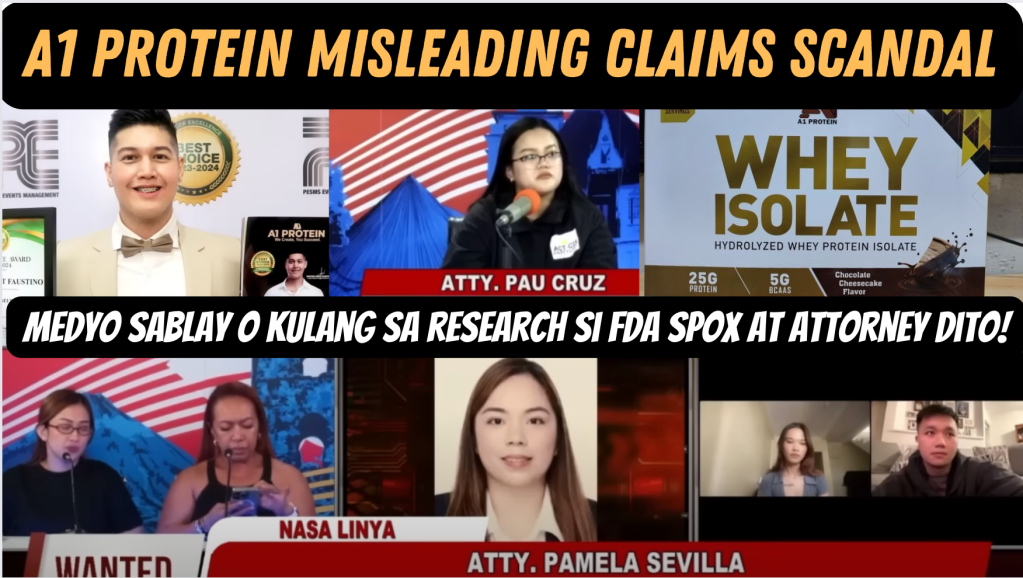
A local whey protein brand, A1 Protein, has stirred controversy among bodybuilding enthusiasts and the fitness industry after revelations of mislabeling and FDA regulation violations.
These violations and misleading claims could potentially endanger the health of consumers.
A1 Protein, owned by businessman Justine Kent Faustino, sells whey protein products and food supplements.
The issue came to light through online posts by fitness enthusiasts who had the products tested in labs, revealing significantly higher sugar content than disclosed on the labels.
The controversy escalated when franchisees of A1 Protein took their complaints to the popular show “Tulfo in Action,” known for exposing public grievances.
Among the complainants was Rowena Walters, President of the International Fitness and Bodybuilding Federation and an A1 Protein franchisee.
Walters recounted that she learned about Faustino through her work and was familiar with his reputation for manufacturing affordable fitness products.
Walters was shocked when lab tests on A1 Protein products, which claimed to have low sugar content, revealed excessively high sugar levels.
She said that a Facebook post exposing A1’s misleading claims affected her business, which had just opened in March.

Subsequent tests conducted by Walters and other franchisees confirmed the misleading labels, showing low protein but high sugar content.
One product, A1 Whey Isolate, was found to have 70.32 grams of sugar per 100 grams, far exceeding the claimed low sugar content.
Walters expressed her dismay, noting that bodybuilders typically consume the protein “once or twice a day, every day!”
Franchisees, who paid substantial fees to join A1 Protein—P250,000 for the franchise fee, P300,000 for initial stock, and additional costs for store construction—were demanding refunds amid the scandal.
“Who will buy now? Who in their right mind would buy?” Walters questioned.

In an interview on “Raffy Tulfo in Action,” Atty. Pamela Sevilla, an FDA spokesperson, stated that the administration had issued a warning regarding the distribution of A1 Protein products.
According to an FDA advisory dated October 4, 2022, the public was warned against purchasing A1 Protein Benchmark 100% Whey Protein Concentrate in Caramel Macchiato and Dark Chocolate flavors, as these products were not registered or evaluated by the FDA.
Sevilla’s comments further fueled the controversy.
She incorrectly stated, “For example, for whey protein products, as long as there is no claim that it is sugar-free, the sugar content, which is considered an additive, has a limitation of 0.5 milligrams of sugar per 100 grams.” The correct regulation specifies 0.5 grams of sugar per serving or 100 grams.
When asked if A1 Protein violated regulations by having 70 grams of sugar in one of its products, Sevilla reiterated, “As long as there is no claim that the product is no sugar or sugar-free, there is no limitation on sugar content,” which did not address the core issue of mislabeling.

When asked again if it’s acceptable to mislead the public by lying about the sugar content of a product, Sevilla simply repeated her previous answer, stating that there’s no limitation on sugar content “as long as nakapag-comply po siya sa standards.”
Atty. Pamela Sevilla’s statements regarding the sugar content in whey protein products have raised concerns about the accuracy of her interpretation of FDA regulations.

To clarify, the FDA has stringent rules regarding the labeling of nutritional content, including sugar.
If a whey protein product claims to contain 2 or 5 grams of sugar but actually contains over 30 to 70 grams, several FDA regulations regarding mislabeling and false advertising would likely be violated.
Here are the relevant regulations:
Food Labeling Regulations:
- FDA Administrative Order No. 2014-0030: This order outlines the general labeling requirements for prepackaged food products in the Philippines.
- Section 15 of Republic Act No. 3720 (Food, Drug, and Cosmetic Act): This section prohibits the sale of any food that is falsely labeled or misleadingly advertised.
Specific Nutrient Content Claims:
- FDA Circular No. 2012-015: This circular provides guidelines for making specific nutrient content claims on food labels, such as “low sugar” or “sugar-free.” If a product claims to contain only 2 grams of sugar but actually contains over 30 grams, it would be misleading and in violation of these guidelines.
Consumer Protection:
- Republic Act No. 7394 (Consumer Act of the Philippines): This act aims to protect consumers against deceptive, unfair, and unconscionable sales acts and practices. Mislabeling a product’s sugar content to mislead consumers could be considered an unfair trade practice under this law.
Violation of these regulations could result in penalties such as fines, product recalls, or other enforcement actions by the FDA Philippines.
 The Daily Netizen