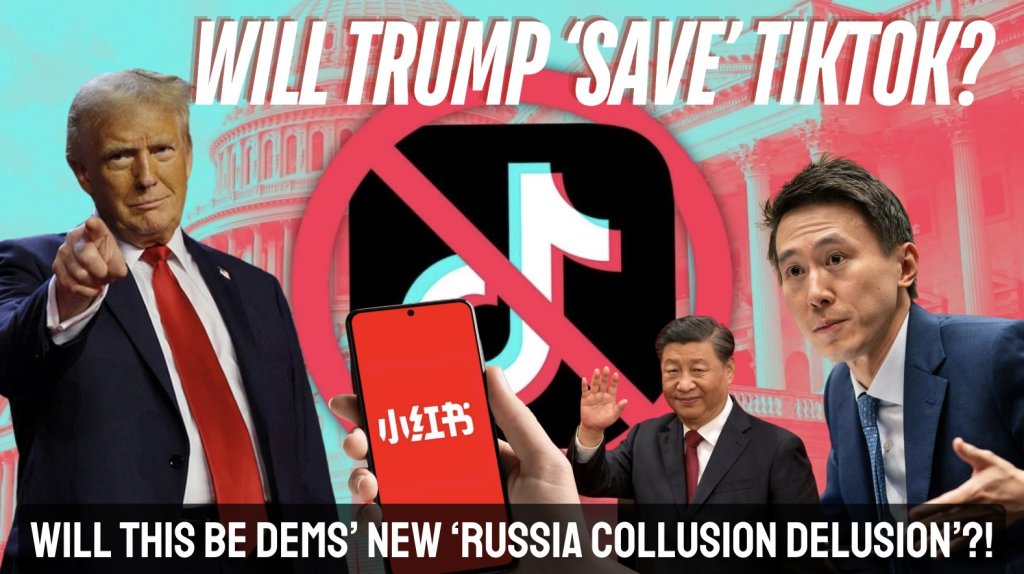
Imagine banning one app to protect national security, only to inadvertently push millions of users to an even less regulated platform.
The U.S. government’s decision to ban TikTok, championed by national security concerns, may have backfired spectacularly.
\With a migration to another Chinese-owned app, Red Note, and political dynamics heating up, could this TikTok ban become the Democrats’ next narrative against Trump—their new “Russia collusion delusion”?
The Ban That Sparked a Mass Exodus
When the U.S. Supreme Court upheld the TikTok ban on January 17, 2025, the stage was set for a digital and political upheaval.
The decision mandated TikTok’s parent company, ByteDance, to divest by January 19 or face a ban.
Yet, this move pushed American users to Red Note, a lesser-known Chinese app. Ironically, the effort to limit Chinese influence may have strengthened it, as Red Note’s opaque data practices and stricter censorship raised new concerns.
Tracing the Ban: From Trump to Biden and Back
Trump’s First Crackdown: In 2020, President Trump declared TikTok a national security threat. Executive orders sought to force ByteDance to sell TikTok to a U.S. company.
Negotiations with Microsoft and later Oracle-Walmart fell apart, and legal battles stalled the process. Despite Trump’s efforts, TikTok remained operational under ByteDance’s control.
Biden’s Alternative Approach: President Biden rescinded Trump’s outright ban in 2021, opting for a more measured regulatory approach.
However, mounting bipartisan pressure led to the 2024 Protecting Americans from Foreign Adversary Controlled Applications Act.
This legislation reinstated the mandate for ByteDance to divest or face a ban, setting the stage for the Supreme Court decision.
The Supreme Court’s Historic Decision: In a unanimous ruling, the Court upheld the ban, emphasizing national security risks.
TikTok’s CEO, Shou Chew, expressed frustration at the lack of clarity on enforcement. Meanwhile, President-elect Trump hinted at reconsidering the ban, signaling potential negotiations.
The Trump Factor: What’s Next for TikTok?
As Trump prepares for his second term, TikTok’s fate hangs in the balance.
Trump’s reaction to the Supreme Court decision was measured, suggesting he might extend the divestiture deadline or negotiate a deal to keep TikTok operational under stricter U.S. oversight.
Pam Bondi’s Role: Trump’s Attorney General nominee, Pam Bondi, has remained non-committal on TikTok, hinting at a strategic approach.
Trump could use TikTok as leverage in broader negotiations with China, aligning with his “deal-maker” persona.
Potential Buyers in the Spotlight: Entrepreneurs like Kevin O’Leary and tech magnate Elon Musk have shown interest in acquiring TikTok.
Musk’s involvement would align with his expansionist vision, while O’Leary’s grassroots campaign could reshape TikTok into a U.S.-owned platform.
However, any deal would face intense scrutiny.
Democrats and the Deep State: A New Narrative?
Could the TikTok ban morph into a political weapon? Democrats might seize on Trump’s handling of the issue, framing it as collusion with China.
This narrative could parallel their previous Russia investigation efforts, alleging Trump’s leniency toward foreign adversaries.
- Collusion Allegations: Democrats might claim Trump’s willingness to negotiate TikTok’s survival benefits China, echoing accusations of foreign favoritism.
- Security and Voter Manipulation: By linking TikTok’s popularity with younger, liberal voters, critics could argue Trump’s actions aim to sway public opinion or compromise security.
- Media Amplification: Supportive outlets could bolster this narrative, framing Trump’s TikTok decisions as undermining national interests.
TikTok’s Uncertain Future: A Bold Prediction
As January 19 looms, TikTok’s shutdown appears imminent—or does it? Here’s what might unfold under Trump:
- Extended Deadline: Trump could delay enforcement, citing ongoing negotiations or progress in ensuring data security.
- Negotiated Deal: TikTok might survive under new U.S. ownership or stringent oversight, with Trump framing the resolution as a diplomatic victory.
- Leverage in U.S.-China Relations: Trump could use TikTok as a bargaining chip, strengthening his position in trade and security talks with China.
The TikTok saga is far from over. What began as a national security initiative has evolved into a political battleground, with Trump at its center.
As Democrats gear up to weaponize the issue, and millions of users await clarity, the fate of TikTok—and its implications for U.S.-China relations—rests on the unpredictable tides of American politics.
Will TikTok’s resilience outlast the political storm, or will it become the newest symbol of global tech power struggles?
 The Daily Netizen