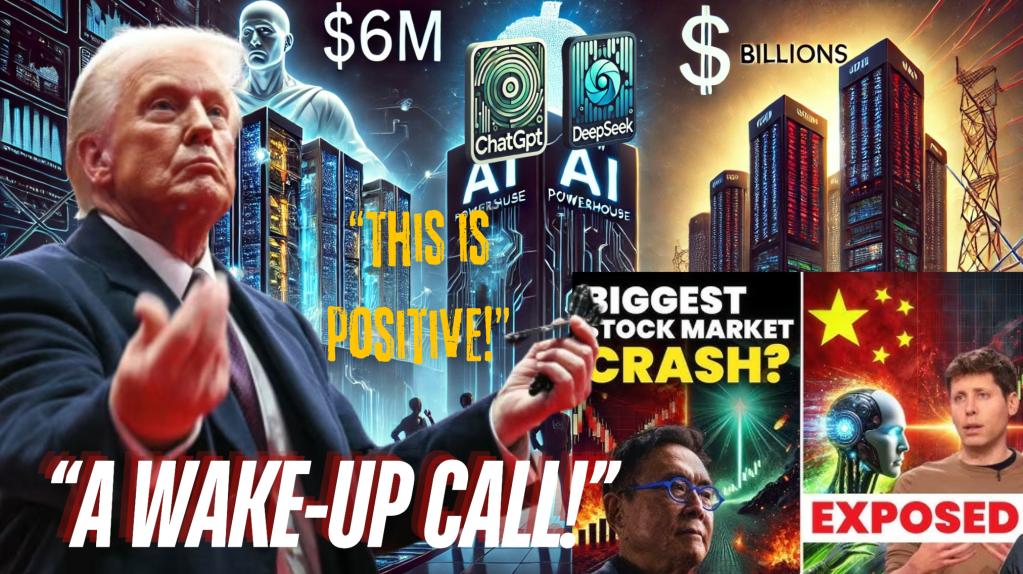
January 2025. The world of artificial intelligence is rocked by an unexpected revelation. A new AI powerhouse emerges—not from Silicon Valley, but from China.
And the cost? A mere $6 million. Compared to OpenAI’s multibillion-dollar investments, the numbers don’t add up. What’s going on? Is America’s AI industry built on a financial illusion? And why is former President Donald Trump calling this a wake-up call?
Here’s Pres. Donald Trump’s statement: “The release of DeepSeek AI from China should be a wake-up call for our industries. We need to be laser-focused on competing to win!”
But there’s something deeper at play here. DeepSeek didn’t just disrupt the AI race—it exposed something sinister: the possibility of a financial bubble, or even a scam, within America’s AI industry.
The AI Bubble—A House of Cards?
Let’s talk numbers. DeepSeek, an AI startup from China, built an open-source model that rivals, if not surpasses, OpenAI’s cutting-edge technology.
The cost? Just $6 million. Meanwhile, OpenAI, backed by Microsoft and funded by hedge funds, has burned through tens of billions of dollars developing AI.
And the impact? A market-wide collapse. Tech giants lost over $1 trillion in market capitalization in a single day. NVIDIA alone saw a historic $589 billion wipeout.
So, let’s ask the big question: If China can build world-class AI for a fraction of the cost, where did all that OpenAI money go?
Was it truly needed for AI development, or is this the biggest financial grift of the 21st century?
But now, it seems there’s a concerted effort to undermine DeepSeek. American media is openly speculating that Chinese AI developers may have used powerful Nvidia chips, implying foul play. Is this an attempt at damage control?
The narrative being pushed suggests that developing AI as powerful as DeepSeek for just $6 million is impossible—so they must have cheated, leveraging American technology.
For outsiders like us, even those critical of the Chinese government, the response is simple: If these claims are true, let the American AI developers and their media allies provide concrete evidence.
Hedge Funds & The AI Gold Rush
Follow the money. OpenAI’s rise has been fueled by venture capitalists and hedge funds, hungry for the next trillion-dollar opportunity.
Sam Altman, the face of OpenAI, has orchestrated funding rounds worth billions.
But DeepSeek’s sudden emergence raises serious questions: Was AI ever as expensive as we were led to believe? Were companies like OpenAI artificially inflating costs to extract massive funding and investor hype?
One thing is clear—DeepSeek’s arrival has exposed something unsettling.
For years, we were told that AI required massive data centers, tens of thousands of NVIDIA GPUs, and limitless funding.
But DeepSeek shattered that narrative by producing a high-performing AI model at a fraction of the cost.
Think about it—if a Chinese startup with a modest budget can outperform billion-dollar tech giants, what does that say about the efficiency—or inefficiency—of America’s AI industry?
Could it be that hedge funds and investors propped up an AI bubble to create artificial scarcity and keep profits flowing?
The Industry Responds
With the industry reeling, OpenAI is scrambling to stay competitive. They’ve introduced their own ‘Operator’ feature, allowing AI to interact with websites and applications autonomously.
But the question remains—are these last-minute innovations, or desperate attempts to maintain relevance?
As AI companies struggle to adapt, China continues its march forward.
DeepSeek isn’t just a standalone achievement—it’s a signal that China’s AI industry is operating with ruthless efficiency, unburdened by Wall Street speculation.
It’s not just DeepSeek.
China is also making strides in AI-driven 3D modeling and automation. If America’s AI bubble bursts, will China take the lead in global AI supremacy?
The Future of AI—Reckoning or Renaissance?
The American AI industry now stands at a crossroads. Either it adapts and competes with China’s leaner, more efficient models, or it risks collapsing under the weight of its own financial excesses.
The trillion-dollar question is this: Was America’s AI industry built on true innovation, or on an unsustainable financial illusion?
Trump called it a wake-up call. The market calls it a bloodbath.
But history might call it something even bigger—the moment America’s AI empire was exposed.
What do you think? Is DeepSeek the beginning of a new AI era, or the moment America’s tech dominance began to unravel?
 The Daily Netizen