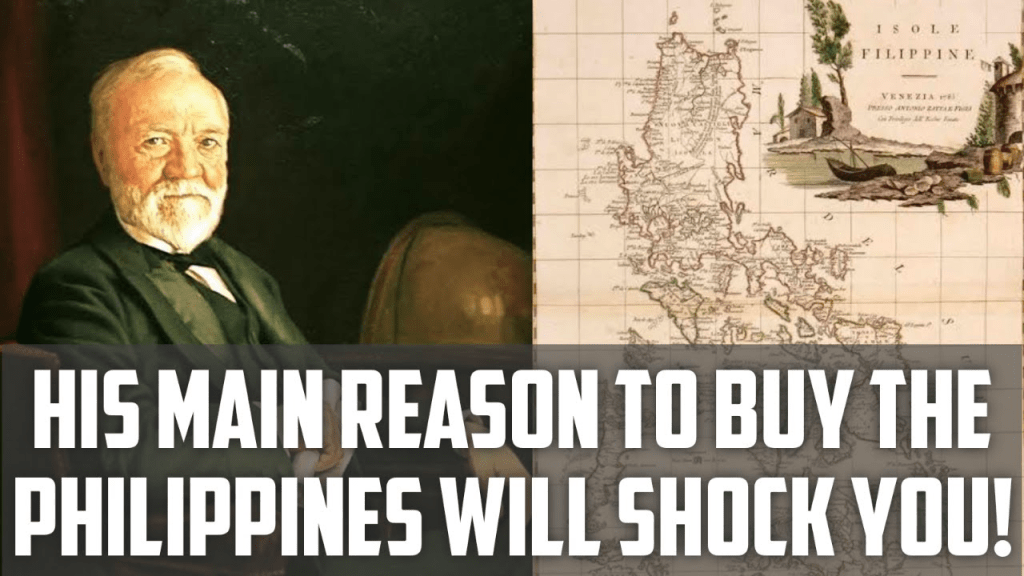
Unraveling the true reasons behind Andrew Carnegie’s proposed purchase of Philippine independence reveals a deeper motivation that extends beyond compassion or philanthropy.
While Carnegie’s offer to buy the Philippines is often associated with his benevolent nature, delving into his own words sheds light on the underlying factors that drove his interest. It becomes clear that his aspirations were rooted in self-interest and concerns about America’s economic well-being.
Carnegie’s Perspective
In his own words, Carnegie expressed reservations about governing an undeveloped country of millions, consisting of what he referred to as “alien races.” He argued that the Philippines, with its population bitterly divided and ignorant of American language and institutions, presented insurmountable challenges.
Carnegie stated, “The Philippines have about seven and a half millions of people, composed of races bitterly hostile to one another, alien races, ignorant of our language and institutions. Americans cannot be grown there.”
Economic Considerations
While philanthropy played a role in Carnegie’s actions, his primary concern lay in America’s economic well-being. He questioned the economic benefits of occupying the Philippines, highlighting the islands’ history of exploitation by Spain.
Despite Spain’s control, the financial gains were minimal, with estimated revenue of £2,715,980 and expenditures of £2,656,026, resulting in a meager net profit of about $300,000. Carnegie saw limited potential for the United States to reap economic rewards from the Philippines, dampening his enthusiasm for the investment venture.
He argued: “The islands have been exploited for the benefit of Spain, against whom they have twice rebelled, like the Cubans. But even Spain has received little pecuniary benefit from them. The estimated revenue of the Philippines in 1894-95 was £2,715,980, the expenditure being £2,656,026, leaving a net result of about $300,000.”
Carnegie’s perspective on the Philippines as an investment venture was far from optimistic. He believed that the challenges of governing an unfamiliar territory, coupled with the perceived hostilities among different races, made it an unattractive proposition. In his eyes, the Philippines was not a good investment to take on, as he deemed the potential financial return to be insufficient. According to Carnegie, the estimated revenue of the Philippines was relatively small, and even Spain, which had twice faced rebellions in the islands, received little pecuniary benefit from its control.
In light of this, Carnegie concluded that the only way for the United States to recoup its investment in the Philippines was through further oppression of the early Filipinos. He controversially suggested that the United States could obtain any significant revenue from the inhabitants only by subjecting them to the same oppressive methods employed by the Spanish. This dark assertion indicates a willingness to perpetuate injustice and exploitation for financial gain. “The United States could obtain even this trifling sum from the inhabitants only by oppressing them as Spain has done,” he said.
Carnegie’s apprehensions and calculations stood in contrast to the United States’ ambitions. The nation, hungry for global influence and eager to test its military might, sought to establish a strategic presence in the Asia Pacific region. The desire for expansion and a demonstration of power outweighed Carnegie’s concerns, shaping the course of history.
Implications and Reflections
Understanding Carnegie’s true motivations invites speculation about alternate scenarios in Philippine history. What if the United States had accepted Carnegie’s offer? Could early Filipinos have successfully governed themselves amidst cultural divisions?
Would the archipelago have retained its distinct regional identities, such as the historical sultanates in Mindanao? Furthermore, given the socialist leanings of some early Filipino intellectuals and policymakers, one might ponder whether the Philippines could have become Asia’s first official socialist nation.
 The Daily Netizen