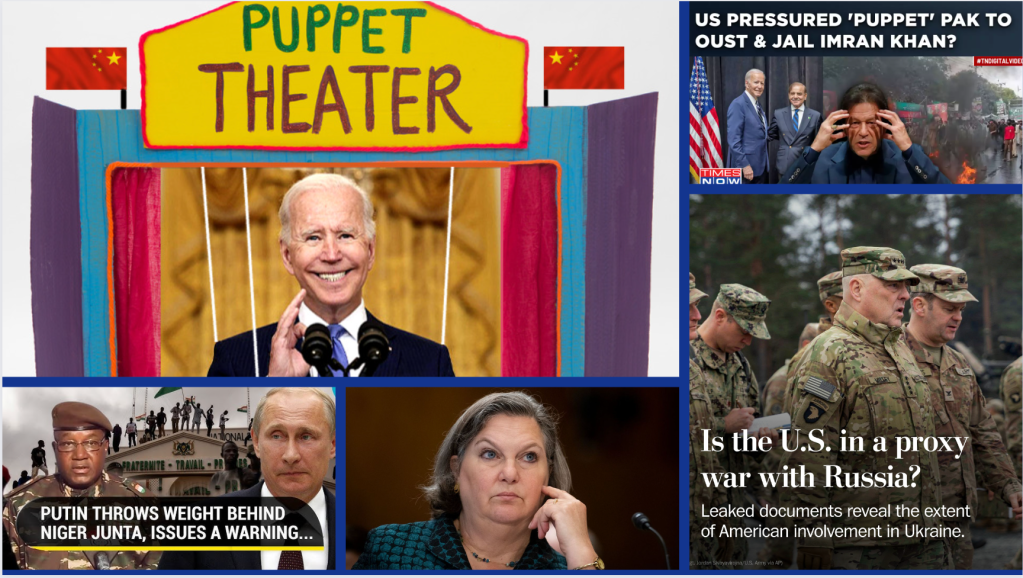
A puppeteer’s strings are often hidden behind the grand stage of power, orchestrating maneuvers that shape nations and destinies. Enter U.S. President Joe Biden – a figure who, to many, embodies the very essence of a puppet master’s creation. His ascent to the White House, seemingly as a democrat figurehead, has exposed a world where the Deep State’s influence is as potent as it is pervasive.
As the curtains drew open on Biden’s presidency, the stage was set for a series of geopolitical moves that showcased his role as the ultimate puppet of the Deep State. The debacle in Afghanistan is a glaring example – a chaotic troop exit orchestrated by the U.S. Military Industrial Complex that led to the Taliban’s swift takeover. It’s a scenario that appears to align seamlessly with the Complex’s insatiable appetite for perpetual warfare.
But the script didn’t end there. Mere weeks after Biden’s inauguration, the spotlight shifted to Ukraine. The nation became a pawn in the Deep State’s grand chessboard, a pawn that would kickstart a proxy war against Russia. It was a calculated move that showcased Biden’s position as the puppet master’s most ideal creation, willing to advance the Complex’s war agenda.
However, the play took an unexpected twist. Enter Pakistan’s Prime Minister Imran Khan, a leader who dared to remain neutral on the Russian invasion of Ukraine. What followed was a revelation straight from the playbook of a political thriller. The Biden State Department, according to a classified Pakistani government document obtained by The Intercept, encouraged the Pakistani government to oust Khan, thereby illustrating the puppet master’s reach in global politics.
The intrigue continues. Recent reports suggest that Biden’s regime, or its Deep State puppeteers, may be plotting a coup in Niger. Victoria Nuland, Biden’s trusted aide and a specialist in orchestrating coups, met with military junta members, setting the stage for what CNN calls a “significant diplomatic push to restore democratic rule.” The objective? To engineer regime change and reinstate a U.S.-backed president. The puppeteer’s reach extends across borders, manipulating nations like pawns on a global stage.
Yet, this isn’t the first time Nuland’s hands are caught in the web of geopolitical manipulation. In 2014, she infamously selected Ukraine’s next president after the elected one was ousted in a U.S.-supported coup. The shadows of her influence stretch far and wide, casting doubt on the true motives behind global political maneuvers.
Enter Joe Rogan, the world’s most popular podcaster. In a conversation with comedian Tim Dillon, Rogan unveiled a statement from former President Donald Trump – a revelation that sheds light on the ultimate goal of the U.S. Military Industrial Complex: waging wars and asserting global hegemony. It’s a chilling testament to the true motives behind the scenes. Pedo Pete, a term allegedly coined by the problematic presidential son Hunter, is indeed America’s Military Industrial Complex or Deep State’s best and most ideal puppet.
In this political theater, Biden stands as the Deep State’s finest act, a puppet whose strings are skillfully pulled by an entity that thrives on warfare and manipulation. The tale is as riveting as it is alarming, a reminder that the puppet master’s grand design is intricately woven into the fabric of our world. As the curtain falls on each act, the puppeteer’s dance continues, leaving a trail of nations and leaders in its wake.
How the Biden Puppet regime’s State Department ousted a Pakistani PM
The corridors of power are often shrouded in intrigue, where the true puppeteers orchestrate moves that can shape nations. Such is the tale of Imran Khan, Pakistan’s Prime Minister, caught in the crosshairs of a political struggle that bears the hallmarks of a puppet master’s manipulation. The story unfolds with a classified Pakistani government document obtained by The Intercept, revealing a chilling narrative that exposes the Biden State Department’s role in ousting leaders who dare to oppose their hegemonic agenda or even to remain neutral in the face of proxy wars.
In a pivotal meeting held on March 7, 2022, the U.S. State Department, acting as the puppeteer behind the scenes, encouraged the Pakistani government to remove Khan from power. The reason? His neutrality towards the Russian invasion of Ukraine, a stance that clashed with the Deep State’s game plan. This meeting, shrouded in secrecy, becomes a focal point of scrutiny, controversy, and speculation within Pakistan’s political landscape.
The aftermath of this clandestine meeting sends shockwaves through the global political arena. Just one month later, a no-confidence vote is held in Pakistan’s Parliament, leading to Khan’s ousting from power. The strings of influence reach far and wide, with suspicions that Pakistan’s powerful military backed the move. Khan and his supporters find themselves ensnared in a struggle with both the military and civilian allies, as the narrative of a U.S.-orchestrated ousting gains traction.
The leaked Pakistani cable, a window into the puppeteer’s methods, exposes a two-pronged approach – offering carrots and wielding sticks. The State Department promises warmer relations if Khan is removed, while isolation is threatened if he remains. The intricacies of this manipulation are unveiled, a masterful display of power play that exposes the depths to which the puppeteers will go.
Assistant Secretary of State for the Bureau of South and Central Asian Affairs, Donald Lu, emerges as a key player in this diplomatic intrigue. The cable reveals his forthright language in addressing Pakistan’s stance on Ukraine. He questions the aggressive neutrality adopted by Pakistan, casting doubts on its true intentions. Lu’s mention of internal discussions with the U.S. National Security Council underscores the orchestrated nature of this move.
The specter of a no-confidence vote looms large, a sword hanging by a thread over Khan’s leadership. Lu’s assertion that a successful vote would absolve Khan in Washington’s eyes, provided an unsettling insight into the depths of manipulation at play. The pressure exerted by Lu on behalf of the State Department is a striking revelation of puppet strings tugged from afar.
The aftermath of this intricate maneuver is chillingly apparent. Khan’s removal from power is followed by a warming of relations between the U.S. and Pakistan, as promised in the meeting. The puppeteer’s influence is undeniable, as diplomatic dynamics shift with Khan’s departure.
As the drama unfolds, it becomes evident that Khan’s fate was indeed hanging by a thread at the time of that fateful meeting. This revelation shines a spotlight on the Biden administration’s message to Pakistan’s power players, indicating a promise of better outcomes with Khan’s removal. The puppeteer’s role is laid bare, sending a clear message to those who dare to oppose their designs.
The web of manipulation expands beyond borders, with the Biden State Department’s meddling in Niger’s affairs echoing the same playbook. The tendrils of puppetry stretch far and wide, demonstrating that even leaders of sovereign nations can be mere pawns in a larger game.
The story of Imran Khan’s ousting serves as a chilling warning, a testament to the puppeteer’s ability to shape destinies and topple leaders who refuse to toe the line. In this intricately woven narrative, Biden’s presidency emerges as a stage for the Deep State’s grand design, where global leaders are but puppets on strings, manipulated by those who wield power from the shadows.
 The Daily Netizen