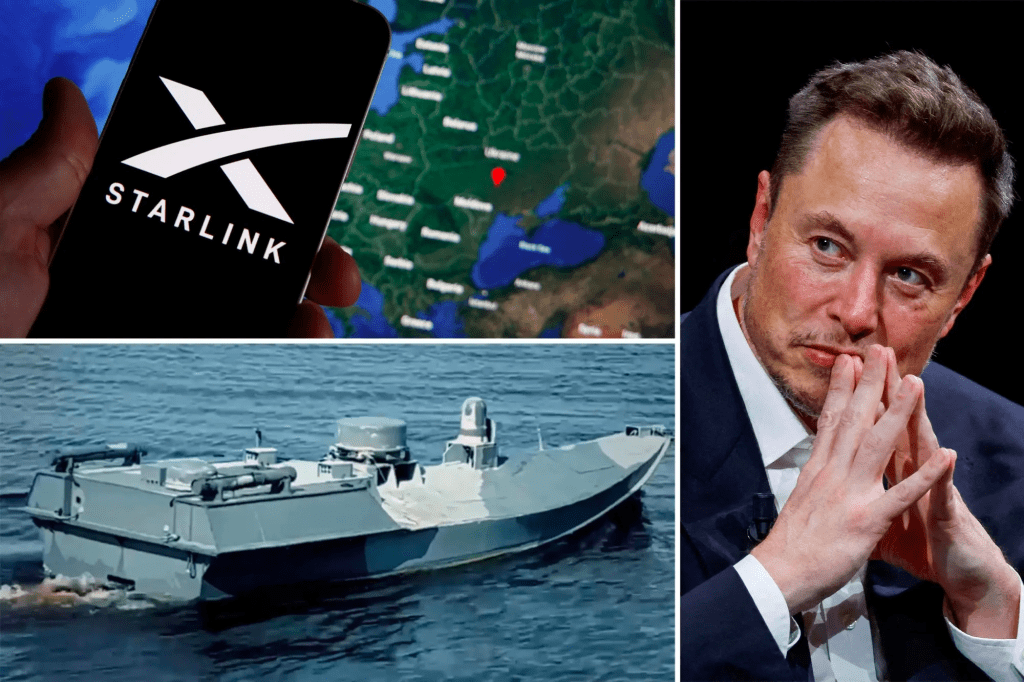
Elon Musk, the modern-day tech visionary with an impressive list of titles – CEO of Tesla, founder of SpaceX, and now the owner of the social media giant X (formerly Twitter), is making headlines once again.
In a sneak peek from an upcoming biography penned by the accomplished biographer Walter Isaacson, who has previously explored the lives of luminaries like Steve Jobs and Albert Einstein, Musk’s role in preventing what could have been a catastrophic World War III comes to light.
In a revelation reminiscent of Tony Stark, the fictional genius behind Iron Man, Musk is depicted as a key player in averting a potential nuclear conflict between Russia and Ukraine. This revelation stems from an excerpt in Isaacson’s biography.
Isaacson’s account suggests that Musk, in an audacious move, took action to disable his own company’s satellite communication networks, operated under the banner of Starlink.
These networks were allegedly being used by the Ukrainian military to orchestrate precision attacks on the Russian naval fleet stationed in Sevastopol, Crimea.
The Ukrainian forces had employed Starlink’s cutting-edge technology to guide a fleet of six small drone submarines, each laden with explosives, toward their intended targets. However, according to Isaacson’s narrative, Musk’s intervention caused these drones to lose connectivity, leading them to wash ashore harmlessly.
However, Musk vehemently disputes this version of events.
In a post on X, he vehemently asserts that Starlink had never been operational in the Crimea region. He went further, categorically denying any action on SpaceX’s part to deactivate their network.
Responding to entrepreneur Mario Nawfal, a prominent voice on X following Musk’s acquisition of the platform, Musk made it unequivocally clear that SpaceX had not issued any covert instructions to engineers to disable Starlink’s satellite communications.
He clarified that, despite requests from government authorities to activate Starlink in the conflict zone, he had firmly declined, fearing that such a move would render SpaceX explicitly complicit in an act of war and exacerbate the conflict further.
Musk’s outspoken rebuttal introduces a twist to the narrative, casting a shadow of doubt over the claims made in Isaacson’s forthcoming book. Isaacson, who had spent months shadowing Musk to craft his biography, has now seen his account of events openly contested by the man himself.
Musk’s association with Ukraine was first established in February 2022 when Russia disrupted the country’s communication systems, signaling an impending full-scale invasion. Responding to impassioned pleas from Ukrainian President Volodymyr Zelenskyy and his ministers, Musk provided millions of dollars’ worth of Starlink satellite terminals, which swiftly became a lifeline for Ukraine’s military operations.
As the calendar flipped to October 2022, the cost of supporting Starlink in Ukraine had skyrocketed into the millions for Musk’s SpaceX. In a tweet, Musk publicly affirmed SpaceX’s financial commitment to Ukraine, leaving no room for ambiguity regarding their pro-Ukraine stance. Nevertheless, funding issues reared their head as Ukraine grappled with meeting its financial obligations, leading to over 1,300 Starlink terminals going offline due to unpaid bills.
Ukraine had been paying a steep monthly fee of $2,500 per terminal, a stark contrast to SpaceX’s standard rate of $110 per month for regular Starlink users. The cumulative monthly bill, totaling a staggering $3.25 million, tested the partnership between the two entities.
Isaacson’s biography also peels back the layers on Musk’s perspective regarding Ukraine’s actions in Crimea, a region that Russia had annexed in 2014. According to the book, Musk arrived at the decision to disable Starlink in the area following discussions with the Russian ambassador to the United States. Musk was reportedly convinced that any attack on Crimea by Ukraine would trigger a nuclear response from Russia, prompting his drastic intervention.
Musk’s bewilderment at his unforeseen entanglement in the conflict shines through. According to the book, he exclaimed, “How am I in this war? Starlink was not meant to be involved in wars. It was meant for people to watch Netflix, chill, get online for school, and do good, peaceful things, not orchestrate drone strikes.”
The eagerly anticipated biography, aptly titled ‘Elon Musk,’ is poised to be a riveting chronicle of the man who has consistently defied conventional norms and expectations. Set to hit the shelves on September 12, it promises to offer readers a deeper insight into Musk’s remarkable journey and his unexpected role on the global stage.
 The Daily Netizen