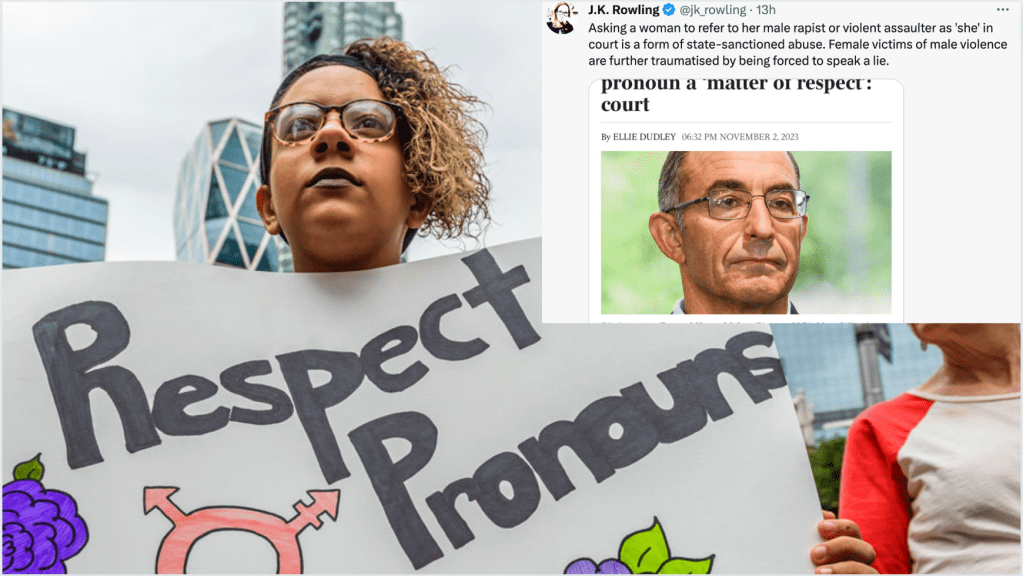
South Australia has become the latest state to embrace the use of preferred gender pronouns within the courtroom, citing respect as the driving force behind this policy.
The move has triggered global condemnation and heated debates regarding gender identity, with billionaire Harry Potter author J.K. Rowling amplifying the issue through her post on social media.
In a post that garnered over 50,000 likes and 10,000 reposts within 24 hours, J.K. Rowling expressed her concerns about the practice: “Asking a woman to refer to her male rapist or violent assaulter as ‘she’ in court is a form of state-sanctioned abuse. Female victims of male violence are further traumatized by being forced to speak a lie.”
Her message was accompanied by a screenshot of an article from “The Australian” titled ‘Right to choose gender pronoun a ‘matter of respect,’ court’.
Rowling went on to describe what she termed “pronoun laws” as rooted in “misogyny,” emphasizing that women’s pain is being disregarded. Critics have labeled the policy as anti-women or anti-“real-women.”
South Australia’s decision follows in the footsteps of Victoria and Queensland, both of which released directives this year mandating that court attendees refer to parties by their preferred pronouns, such as they/them.
In an official statement, SA Chief Justice Chris Kourakis emphasized the importance of respecting gender pronouns, stating, “The Supreme Court, District Court, ERD Court, Magistrates Court, Youth Court, and Coroners Court recognize that the correct pronunciation of names and the use of preferred gender pronouns is a matter of respect and is an important component of ensuring public confidence in the proper administration of justice.”
The practice note released by the court outlines a straightforward process for legal practitioners to provide guidance on preferred gender pronouns before a hearing. It states that practitioners may include the preferred pronoun directly after the name in square brackets, such as “The defendant (they/them)”.
This move towards inclusive language is not unique to South Australia.
In April, Queensland Supreme Court Chief Justice Helen Bowskill issued a similar practice note, recognizing the significance of correct pronunciation and preferred forms of address as a matter of respect. The guidelines in Victoria, also released in April, encourage parties, lawyers, and other participants to advise the court on forms of address, including “Ms,” “Mr.,” and “Mx.”
While South Australia’s pronoun policy has stirred controversy, it reflects a broader trend towards adopting gender-neutral language.
Earlier this year, the South Australian parliament adopted gender-neutral language, making it one of the last regions in the country to do so.
Thousands of individuals, however, have condemned SA’s pronoun policy, expressing concerns that it could be adopted by other countries.
Many have voiced their reluctance to comply, with some suggesting they would be willing to face contempt of court or jail rather than use pronouns that they do not believe reflect the truth.
Personally, I wouldn’t be compelled, I’d take contempt of court. It’s time for mass non-compliance with this bullshit,” Rowling further posted.
“No, I also refuse to be compliant in advancing an ideology that works counter to the interests of women and girls. I won’t call any man – let alone a rapist – ‘she’,” verified user Helen Staniland responded.
Rowling responded to a follower who feared that the “pronoun” law could happen anywhere, saying: “It has happened. Here’s one UK example, where a judge told a woman who was beaten up by a trans-identified male that she showed ‘bad grace’ by refusing to call her attacker ‘she’ in court.”
“I can’t believe we got here. How can people treat women so cruelly? It’s sickening,” posted an X user.
Rowling responded, saying: “Misogyny, my friend. Women’s pain doesn’t count. They must bend the knee to men’s feelings, or be punished for non-compliance.”
“I am in Australia. If I was ever put in such a position I would NOT use that person’s preferred pronouns. Guess I would be in contempt of court then. Oh well. I’ll take my lumps. Whatever ridiculous punishment that were to come my way, would be an honour to shoulder,” posted another verified user Shoshana.
Numerous female users on X have expressed their willingness to face contempt of court or even serve jail time rather than adhere to what they perceive as a stringent pronoun policy.
“I’d happily do time in jail if I was forced to call my rapist anything else than a man,” posted verified user Lanee.
“Forcing the pronoun on others is a matter of disrespect,” said verified user The White Rabbit.
 The Daily Netizen