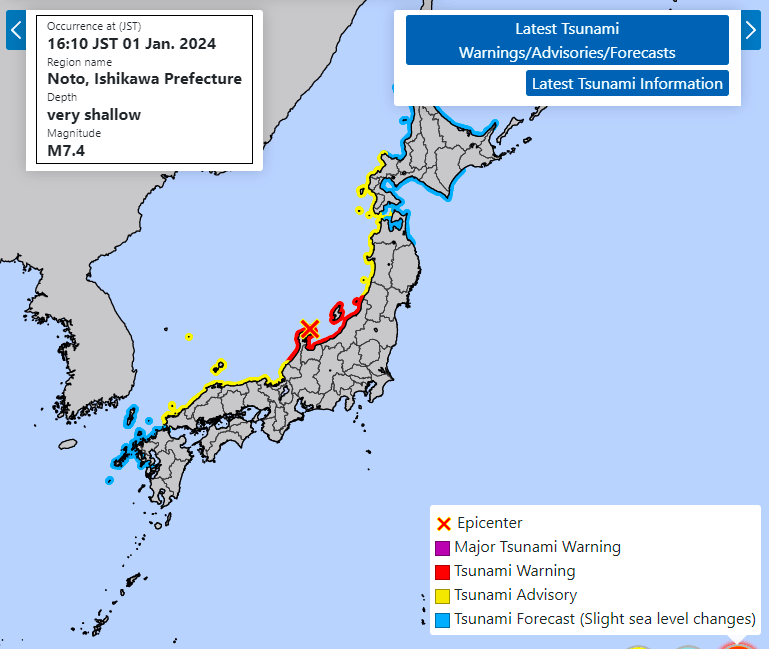
Central Japan, particularly Ishikawa, has experienced a powerful earthquake measuring 7.6 on Monday, prompting the issuance of a tsunami warning and advisories for residents to evacuate and brace for potential aftershocks.
Public broadcaster NHK reported the occurrence of a tsunami, approximately 1 meter high (3.3 feet), along the Sea of Japan’s west coast, with expectations of a larger wave, Al Jazeera reported.
The Japan Meteorological Agency swiftly released tsunami alerts for the coastal prefectures of Ishikawa, Niigata, and Toyama, according to Reuters.
The quake struck the Noto region in Ishikawa prefecture around 4:10 pm local time (07:10 GMT), prompting NHK to broadcast urgent instructions: “All residents must evacuate immediately to higher ground.” Simultaneously, another earthquake warning was issued for Ishikawa.
The possibility of hazardous tsunami waves, reaching heights of up to 5 meters (16.4 feet), loomed along the north coast of central Japan within 300 km (186 miles) of the quake’s epicenter, as indicated by both US and Japanese agencies.
Yoshimasa Hayashi, the top government spokesperson, addressed the public in an emergency news conference, emphasizing that authorities were still assessing the extent of the damage and cautioning residents to be prepared for potential additional seismic activities, according to Al Jazeera.
NHK aired footage depicting buildings collapsing in Ishikawa, while tremors were felt in Tokyo on the opposite coast. Power outages affected over 36,000 households in Ishikawa and Toyama prefectures, according to Hokuriku Electric Power.
In response to the earthquake, Japan’s Nuclear Regulation Authority reassured that no irregularities had been identified at nuclear power plants along the Sea of Japan, including those at Kansai Electric Power’s Ohi and Takahama plants in Fukui prefecture.
Hokuriku’s Shika plant in Ishikawa, located closest to the quake’s epicenter, had already halted its two reactors for routine inspection before the earthquake, experiencing no impact.
South Korea’s meteorological agency raised concerns about potential rises in sea levels in parts of Gangwon province on the east coast.
Given Japan’s vulnerability to earthquakes, the recent event brought back memories of the devastating March 11, 2011 earthquake and tsunami that struck northeastern Japan, claiming nearly 20,000 lives, ravaging towns, and leading to nuclear meltdowns in Fukushima.
 The Daily Netizen