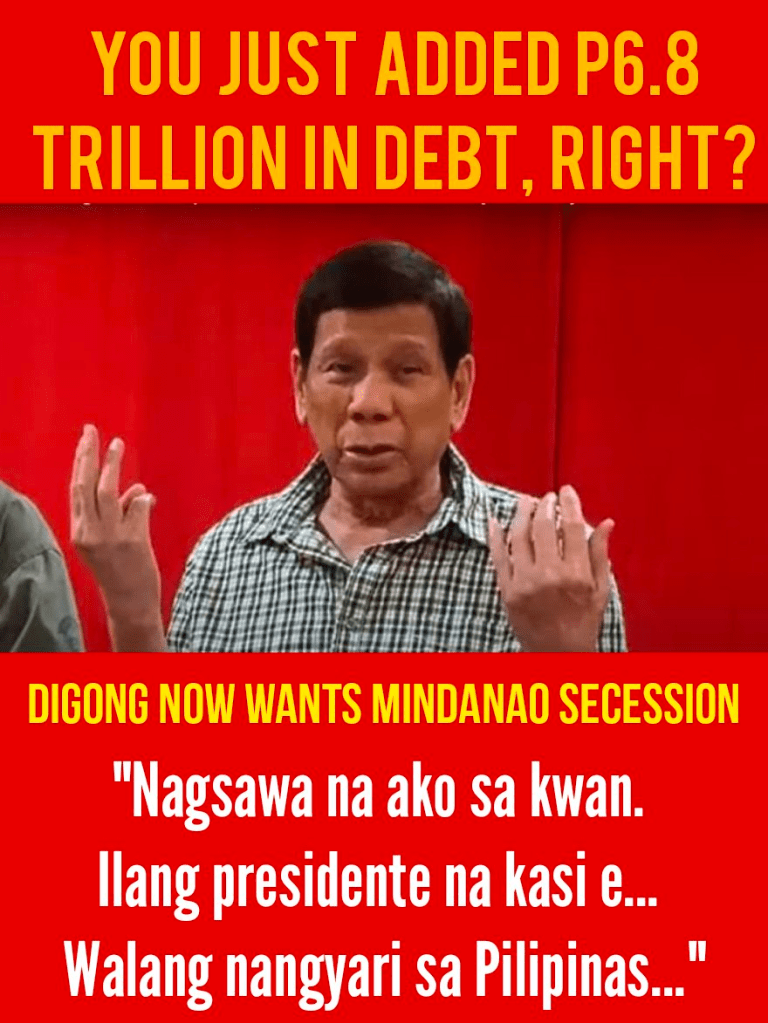
Former Philippine President Rodrigo Duterte’s unexpected call for Mindanao’s secession is now viewed by many as a desperate attempt to divert attention from the International Criminal Court (ICC) investigation into his family and political allies.
However, this move could potentially backfire, further isolating the Dutertes and provoking anger among Filipinos.
Filipino netizens, skeptical of Duterte’s motives, perceive the Mindanao secession as a diversionary tactic against the ICC probe.
Some expressed their suspicions on social media, stating, “It is out of desperation to get away from the ICC.”
In a recent press conference, Duterte outlined plans for a peaceful movement advocating for a “separate and independent Mindanao,” insisting that the process would align with United Nations guidelines and not be a violent endeavor.
This development marks a significant shift in dynamics, exposing the growing rift between the Duterte and Marcos families, formerly known as the “Uniteam” during the 2022 presidential elections.
Choosing Davao del Norte Rep. Pantaleon Alvarez to lead the movement, Duterte justified his decision, citing Alvarez’s expertise and his prior research on the merits of Mindanao’s separation.
“If there will be a separate Mindanao Republic, it could no longer enter Mindanao because Alvarez here will hide me,” Duterte said, employing his customary playful style, leaving many uncertain about the seriousness of his statement.
Duterte clarified, “It is not rebellion, not a bloody one, but we will follow the process provided by the UN to gather signatures, verify these under oath and with the presence of other (witnesses), signify that the people want to separate (from the country).”
Nevertheless, skepticism abounds, with critics seeing this as a calculated maneuver to evade accountability.
“Singapore is a small country, as big as Siargao of Surigao del Norte. It has no resources of its own,” Alvarez said. “Mindanao has a lot of natural resources; we have bigger potential.”
Filipino netizens, echoing the sentiments of Gabriela partylist and other opposition groups, have raised suspicions about Duterte’s motives.
“Ang mensahe ko kay former President Duterte, siya na muna ang bumukod sa Pilipinas. Sumuko na siya sa ICC at tigilan na niya ang mga pakulo niya para iwasan ang mga pananagutan niya sa taumbayan, lalo na sa mga biktima ng extra-judicial killings,” Gabriela Women’s Party Rep. Arlene Brosas said.
The timing of Duterte’s call has also raised eyebrows. Rep. Raoul Manuel questioned the suddenness of the announcement, labeling it as “out-of-the-blue” and suggesting a hidden agenda.
“In fact, the Dutertes just want to turn Mindanao into an escape bunker at a time when they are being hunted by the ICC when the investigation progresses and they are convicted of their crimes against the Filipino people,” Manuel said as reported by PhilStar.
He asserted that the Dutertes might be using the Mindanao issue as a smokescreen to shield themselves from the ICC’s scrutiny.
The potential backlash from the Filipino public looms large, as many view this secession proposal as a way for the Dutertes to secure a safe haven.
Former Sen. Panfilo Lacson dismissed Duterte’s idea as unconstitutional, citing Article I of the 1987 Constitution.
Lacson asserted, “Why secession will not happen,” emphasizing the unity and sovereignty of the Philippine archipelago.
Senate President Juan Miguel “Migz” Zubiri, a Mindanao native, expressed concern over the potential impact on the economy, cautioning against dividing the nation.
Zubiri emphasized, “I think we should slow down with the fighting because what is important is the welfare of the public.”
Critics argue that attempting to turn Mindanao into a refuge may exacerbate the already strained relationship between the public and the Duterte family, especially given the controversial backdrop of Duterte’s “war on drugs.”
 The Daily Netizen